
Traditional e-commerce was built for clicks. Product pages, category navigation, high-res image galleries—all designed to guide a human being down a funnel.
But what happens when the buyer isn’t human?
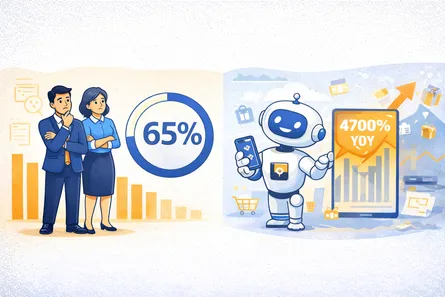
As Google AI Overviews, Perplexity, and ChatGPT evolve from search engines into action engines, the commerce landscape is shifting. AI agents are no longer just summarizing reviews; they are actively researching products, comparing inventory, and completing transactions on behalf of consumers.
To capture this new wave of zero-click buyers, you can’t rely on a traditional web store. You need an Agentic Storefront.
What is an Agentic Storefront?
An Agentic Storefront is an e-commerce infrastructure explicitly designed to be read, navigated, and transacted on by Artificial Intelligence agents.
While a traditional storefront optimizes for human user experience (UX), an Agentic Storefront optimizes for Agent Experience (AX). It provides structured, deterministic data and deterministic checkout APIs that an LLM can parse and interact with flawlessly.

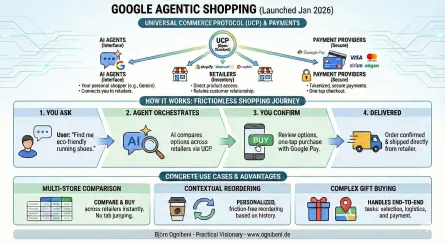
If a customer asks an AI shopping assistant, “Find me size 10 running shoes in blue, under $150, that can be shipped by Tuesday,” an Agentic Storefront can directly supply that data and allow the bot to purchase it without the human ever opening a browser tab.
The Three Pillars of an Agentic Storefront
Building an Agentic Storefront doesn’t mean deleting your React or Astro frontend. It means adding an invisible, AI-first layer beneath it.
1. The Discovery Manifest
Agents don’t have time to crawl your sitemap and infer what you sell. An Agentic Storefront publishes a standard manifest (often at /.well-known/ucp) that declares its existence, its catalog endpoints, and its checkout capabilities.
2. Machine-Readable Inventory
HTML product pages are notoriously difficult for LLMs to scrape reliably. Instead, an Agentic Storefront exposes clean JSON feeds detailing exact SKUs, real-time inventory levels, pricing, and shipping policies.
3. Agentic Checkout APIs
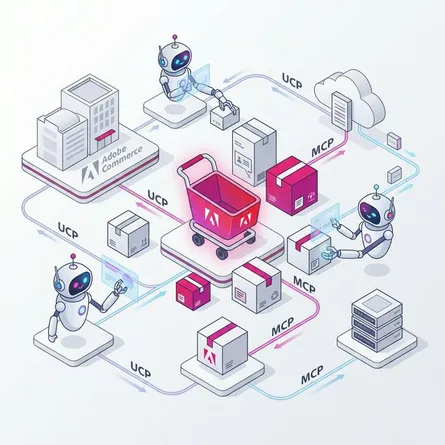
This is the holy grail. While your traditional site uses a visual shopping cart, an Agentic Storefront supports checkout sessions generated via API. Using standards like the Universal Commerce Protocol (UCP), the AI agent can securely pass shipping details and payment tokens to complete the transaction autonomously.
flowchart LR
  A[AI agent] --> M["/.well-known/ucp manifest"]
  M --> F[JSON product feed]
  F --> C[Checkout session API]
  C --> O[Order confirmed]
The agent’s path through an Agentic Storefront: discover, read, transact.
Why Traditional “Headless” Isn’t Enough
Many brands mistakenly believe that a headless architecture automatically makes them AI-ready. This is completely false.
Headless separates the frontend from the backend, but your REST or GraphQL APIs are still entirely custom. An AI agent from Google does not know how your specific cart endpoint is structured. It doesn’t have the custom API documentation for your brand.
An Agentic Storefront relies on universally adopted protocols (like UCP). Instead of expecting every AI agent on the planet to learn your custom APIs, you implement a standard protocol that every AI agent already understands.
The Future is Autonomous
Transforming into an Agentic Storefront ensures that when a consumer delegates their buying power to an AI, your brand is not just visible—it’s ready to transact.