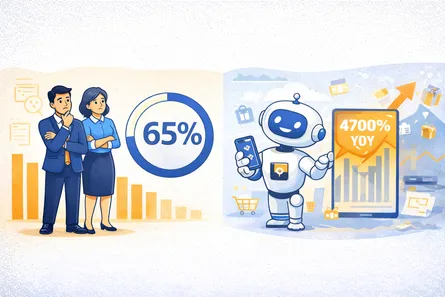

Agentic commerce is reshaping digital retail in three fundamental ways: AI agents are replacing search as the primary discovery mechanism, human intent is being delegated to autonomous agents, and merchants must now optimize for machine recommendation rather than human browsing. The following visual analysis — featuring infographics from Björn Ognibeni’s excellent series — breaks down each shift.
Google’s Agentic Shopping Platform
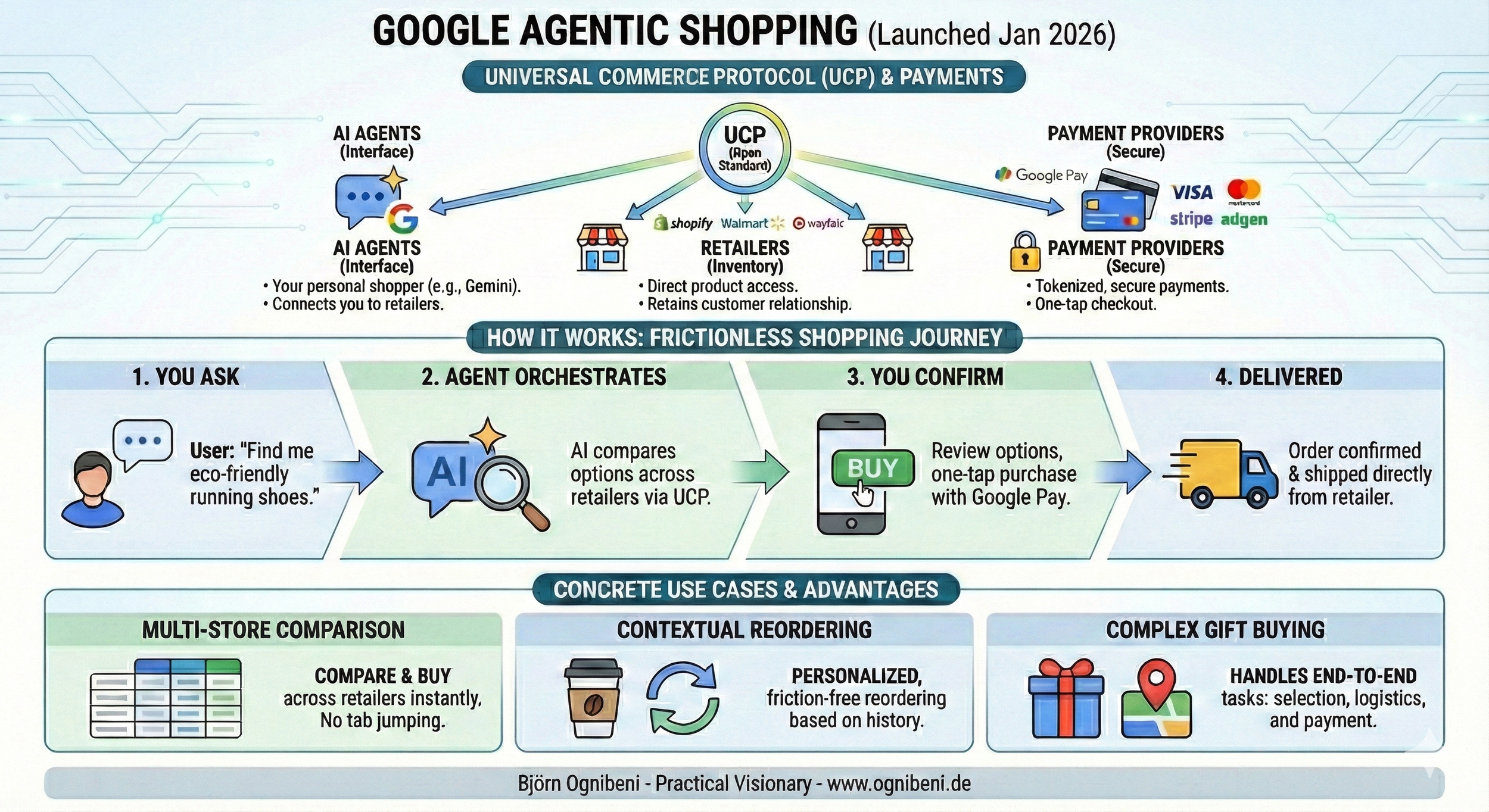 Credit: Infographic by Björn Ognibeni
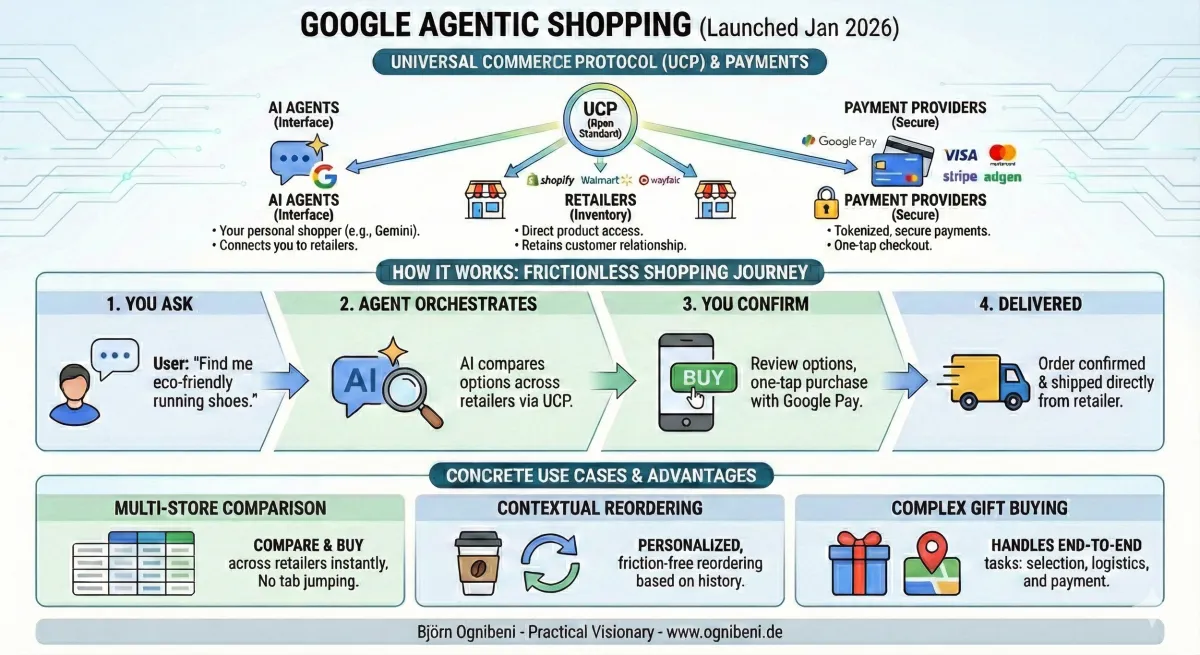
The transition toward an agent-mediated shopping ecosystem fundamentally changes where product discovery happens. As Google and other major tech platforms transition into “Shopping Platforms,” merchants have to ask themselves: are we optimizing our catalogs for humans or for AI agents? In this agentic model, the search engine takes on an active role as a personal shopper, executing transactions right from the AI surface via emerging frameworks like the Universal Commerce Protocol (UCP). Brands must ensure their APIs and structured data readiness are prioritized to remain visible when AI makes the purchasing recommendations.
The Missing Element in Agentic Commerce: the Human
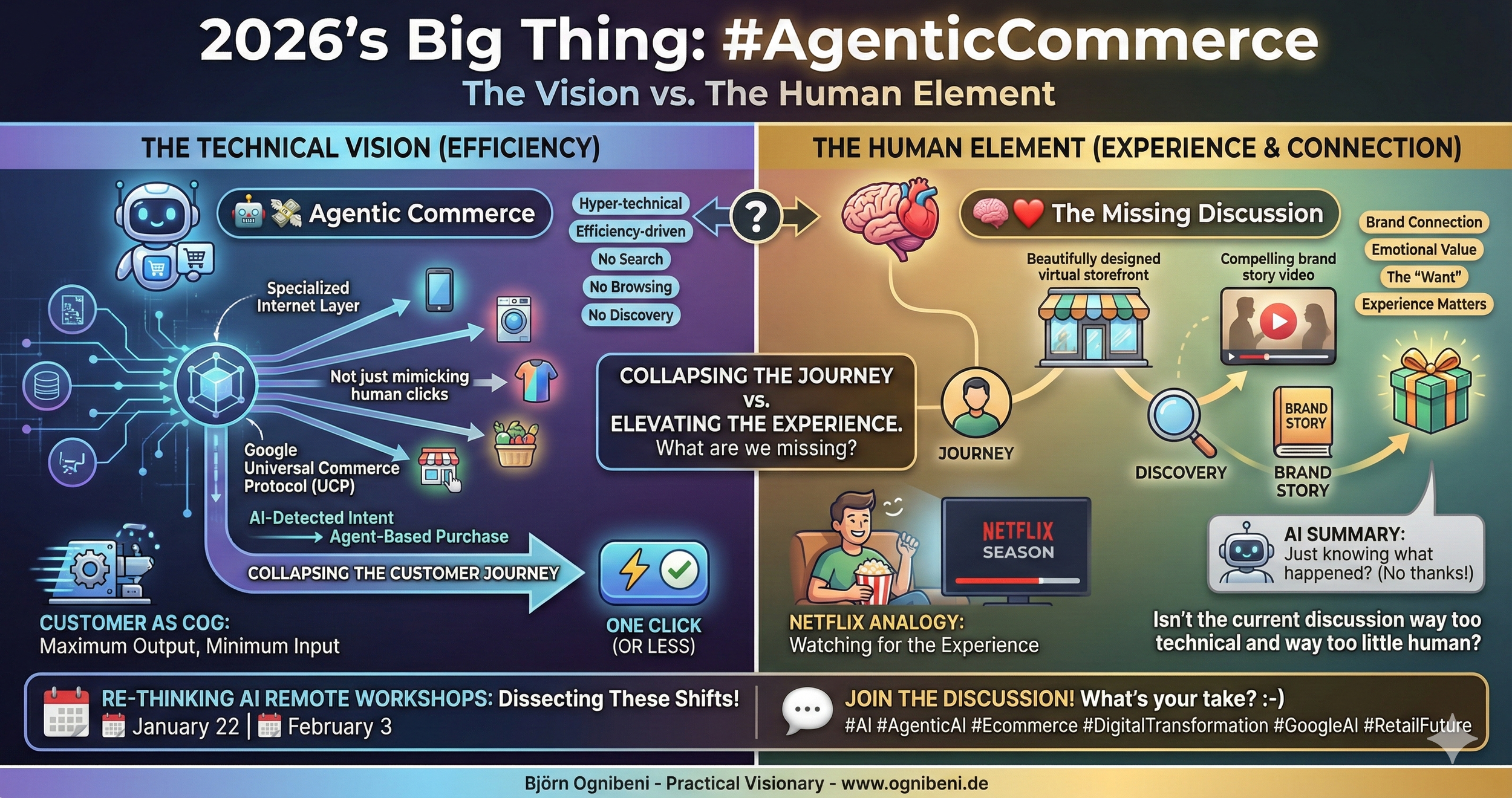 Credit: Infographic by Björn Ognibeni
While the automation of intent-to-checkout is powerful, e-commerce cannot become a purely synthetic interaction. The human element—curation, emotion, nuanced taste, and trust—remains paramount. Agentic commerce doesn’t eliminate the need for human touch; rather, it elevates the human role to that of a creative director or specialized consultant. The systems process the enormous volumes of catalog matching, while humans provide the strategic oversight and the emotional brand connection that prevents shopping from becoming overly commoditized and robotic.
More than just Search - The 4 Modes of E-Commerce
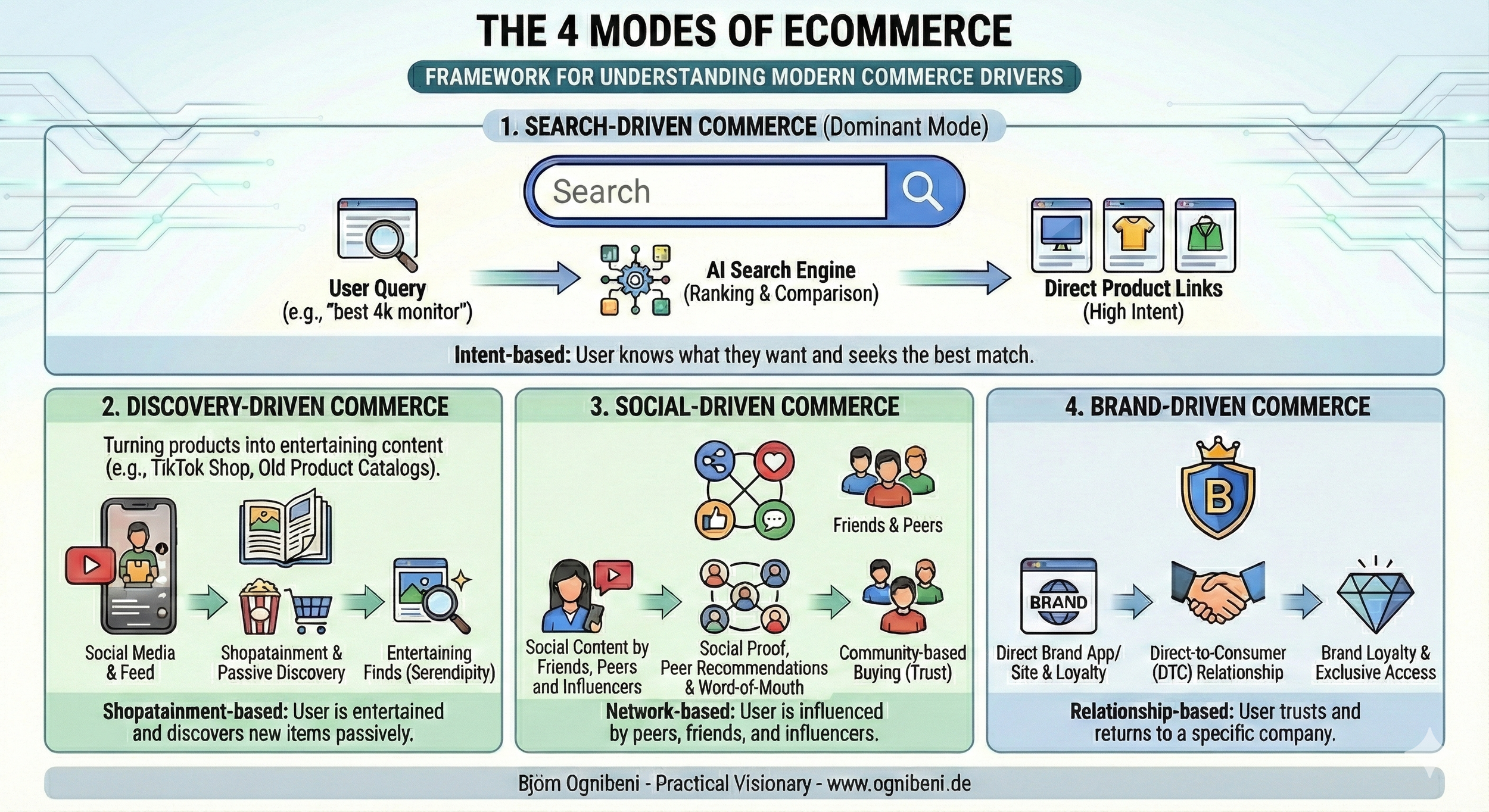 Credit: Infographic by Björn Ognibeni
E-commerce is no longer a monolith. The traditional “Search and Display” grid is merely one mode in an expanding matrix of digital shopping. We are moving toward complex environments where algorithmic discovery (like TikTok grids) meets agentic facilitation (where an AI does the research for you based on a loose brief, like planning an entire living room aesthetic). Retailers must map their current digital offerings against these four distinct modes: Direct Search, Browsing Inspiration, Algorithmic Discovery, and Agent-assisted Action, ensuring they offer journeys tailored to distinct types of buyer intent.
What These Shifts Mean for Merchant Strategy
The three shifts illustrated above — toward agent mediation, toward autonomous intent, toward multi-mode commerce — have concrete operational implications. Here’s how to translate each visual insight into action.
From the Agentic Shopping Platform graphic
The key insight is who controls discovery. In traditional e-commerce, merchants optimize for search engines that rank their own pages. In agentic commerce, a platform intermediary (Google AI Mode, ChatGPT, Perplexity) makes the recommendation — and the merchant’s product data is the input to that decision.
The operational shift: You can no longer rely on a URL in a search result as the primary discovery mechanism. Merchants must ensure their catalog is directly legible to AI systems through structured product data, UCP manifests, and schema markup — before the agent ever considers linking to their storefront.
From the Missing Human graphic
Automation handles the mechanics of matching and transaction. Human judgment remains essential for brand positioning, curation, and emotional resonance — the things that make one product preferable to a technically equivalent alternative.
The operational shift: Content and brand investment doesn’t disappear in agentic commerce — it shifts upstream. The work is now in how products are described, attributed, and positioned in the data that agents read, not in the marketing copy on a product page that agents don’t read.
From the 4 Modes graphic
Different shoppers are in different modes simultaneously. A shopper might discover a brand through algorithmic discovery (TikTok, Instagram), do detailed comparison research via an AI assistant (agentic mode), and complete the purchase through a UCP checkout session — all in one decision journey.
The operational shift: Readiness for agentic commerce doesn’t replace investment in direct search or inspiration channels. It adds a new mode. Brands must be discoverable and transactable across all four modes, because shoppers move between them fluidly within a single purchase decision.
The Quantitative Case
To ground the visual narrative in numbers:
- 4,700% year-over-year growth in AI-driven retail traffic (Adobe Analytics, 2025)
- 65% of retailers have taken no steps to prepare for agentic commerce (Optimizely, 2025)
- 3–5x conversion rate for agent-referred shoppers vs. organic search — they arrive having already decided to buy
- $390B in global retail sales influenced by agentic commerce by 2028 (Salesforce)
The visual shifts illustrated above aren’t speculative. They’re already in the data. The question for merchants is which mode of the four-mode framework they’re optimized for — and whether “agent-assisted action” is one of them.
Further reading: For a technical breakdown of what agentic readiness requires, see our 7-Dimension Agentic Commerce Readiness Framework. To understand the protocol stack behind these shifts, start with What is Universal Commerce Protocol?