
The 7-Dimension Agentic Commerce Readiness framework is ForkPoint’s methodology for evaluating and achieving full readiness for AI agent-driven commerce. The seven dimensions are: AI Discoverability, Protocol Readiness, Data Quality, Transaction Enablement, Trust & Verification, Post-Purchase Experience, and Measurement & Optimization. A brand must score adequately across all seven to capture AI-agent-driven revenue — deficiency in any single dimension can block the entire channel.
This document defines each dimension, explains why it matters, and describes what adequate readiness looks like in practice.
Why a Framework?
Most agentic commerce guidance focuses on a single layer: “implement UCP” or “optimize your schema markup.” That’s necessary but insufficient. AI agents that interact with your commerce infrastructure encounter every dimension simultaneously.
A shopper’s AI agent might:
- Search for a product → AI Discoverability
- Call your UCP manifest to check capabilities → Protocol Readiness
- Query your product feed for attributes and pricing → Data Quality
- Create a checkout session and initiate payment → Transaction Enablement
- Validate your return policy and merchant reputation → Trust & Verification
- Query order status post-purchase → Post-Purchase Experience
- Generate attribution data in your analytics → Measurement & Optimization
flowchart LR
  A["Discoverability"] --> B["Protocol"] --> C["Data Quality"] --> D["Transaction"]
  D --> E["Trust"] --> F["Post-Purchase"] --> G["Measurement"]
The agent’s path through your commerce stack — every dimension is a gate.
That’s the full sequence. A failure at step 3 (incomplete product data) means the agent never reaches step 4. A failure at step 5 (unclear return policy) means the agent recommends a competitor instead. All seven dimensions are in the critical path.
Dimension 1: AI Discoverability
The question: Can AI agents find your products in the first place?
AI discoverability is the practice of making your brand, products, and content visible to AI-powered recommendation systems — Google AI Mode, ChatGPT Shopping, Perplexity, and similar platforms. It is distinct from traditional SEO because these systems don’t crawl and rank pages the same way search engines do.
What discoverability requires
Structured data (Schema.org) Product markup must be comprehensive — not just name and price, but category hierarchy, attributes, availability by region, shipping policies, and review aggregates. Agents parse structured data before page content.
UCP discovery manifest
The /.well-known/ucp endpoint is the formal entry point for UCP-compliant agents. Even if checkout isn’t enabled, having a valid manifest with product feed URL signals to agents that you’re a participatory merchant.
Content entity recognition AI models build a knowledge graph of entities — brands, products, categories, merchants. Appearing in structured references (product databases, review platforms, knowledge bases) increases the probability that a model associates your brand with relevant queries.
GEO-optimized content Blog posts, guides, and product descriptions should open with direct-answer paragraphs that state the key fact or answer the primary question immediately. Language models trained on web content have been shown to cite pages with direct-answer openings at significantly higher rates.
llms.txt and AI crawler access
The llms.txt standard (llmstxt.org) provides AI crawlers with a structured map of your site’s most relevant content. Paired with a correctly configured robots.txt that allows AI crawlers, this ensures models can index your content for recommendation training.
Readiness indicators
- Valid
/.well-known/ucpmanifest - Schema.org Product markup with 15+ attributes per product
llms.txtandllms-full.txtpublished- AI crawlers (GPTBot, ClaudeBot, PerplexityBot) allowed in
robots.txt - Google Merchant Center listing active and verified
Dimension 2: Protocol Readiness
The question: Are agent protocols implemented so AI systems can transact, not just discover?
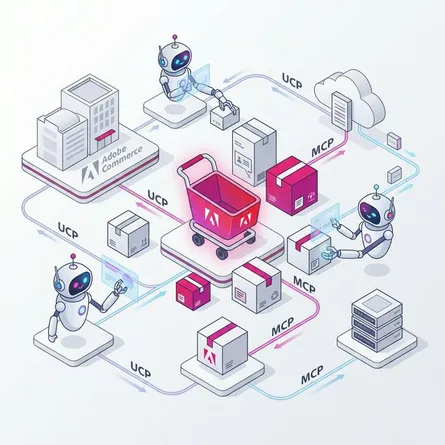
Protocol readiness refers to the implementation of the technical standards that govern how AI agents interact with commerce infrastructure. The three protocols that matter for enterprise commerce are UCP, MCP, and A2A.
Universal Commerce Protocol (UCP)
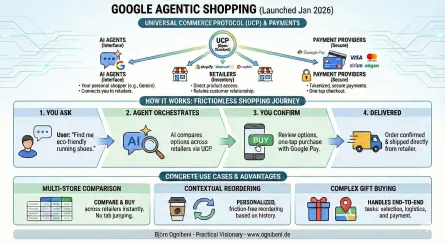
Developed by Google, Shopify, and 20+ partners, UCP is the open standard enabling consumer-facing AI agents to discover products, manage carts, and complete checkout. It’s the protocol behind Google AI Mode purchases.
UCP implementation requires:
- Discovery manifest at
/.well-known/ucp - Product feed API (paginated, filterable)
- Checkout session API (create, update, expire)
- Payment handler integration
- Order status and tracking API
Platform status: Native on Shopify Plus. Custom implementation required on SFCC (use ucp-sfcc), Adobe Commerce, BigCommerce, and headless platforms.
Model Context Protocol (MCP)
Developed by Anthropic, MCP enables tool-using AI systems to query structured data sources through standardized tool definitions. Enterprise B2B buyers’ AI assistants increasingly use MCP to interact with vendor systems.
MCP implementation for commerce exposes tools for:
- Catalog search with semantic filters
- Account-specific pricing and availability
- Order history and account status
- Quote generation
Relevant for: B2B sellers, wholesale, brands with corporate account programs.
Agent-to-Agent Protocol (A2A)
Developed by Google, A2A enables autonomous agent-to-agent communication — allowing buyer AI agents to interact directly with supplier AI agents without human involvement in each transaction.
Relevant for: High-frequency B2B relationships, automated replenishment, enterprise procurement workflows.
Readiness indicators
- UCP manifest validated and live
- Checkout sessions tested with agent simulation
- MCP server operational (if B2B segment exists)
- A2A capability card published at
/.well-known/agent.json
Dimension 3: Data Quality
The question: Is your product data complete, accurate, and structured for machine consumption?
Data quality is frequently the largest gap in agentic commerce readiness — and the most underestimated. Most product catalogs are built for human browsing, not machine querying. AI agents need different data than human shoppers.
What agents need that humans don’t
Attribute completeness. A human shopper can look at a product image and infer dimensions. An AI agent cannot. Every attribute an agent might need to answer a shopper’s question must be explicit in the product data: dimensions, weight, material composition, compatibility, care instructions, certifications.
Attribute consistency. “Color: Navy” in one product and “Color: Dark Blue” in another causes recommendation failures when agents try to filter by color. Attribute values must be standardized across the catalog.
Real-time inventory. Agents recommending out-of-stock products destroy trust in both the agent and the merchant. Inventory data that’s even an hour stale is a problem for high-velocity SKUs.
Pricing accuracy. If your UCP product feed shows $79 and your checkout session returns $89 (due to a promotion that expired), the agent sees a discrepancy it can’t explain to the shopper. Price consistency across all data layers is mandatory.
Variant completeness. Every purchasable combination (size × color × configuration) must be represented in the product feed with its own inventory and pricing. Agents can’t guess at availability — they need explicit variant data.
Common catalog failures
- Missing attributes for 30–50% of SKUs (common in legacy catalogs)
- Promotional copy in description fields instead of factual specifications
- Images without alt text or structured metadata
- Category taxonomy inconsistent across catalog sections
- No machine-readable shipping or returns data at the product level
Readiness indicators
- Catalog attribute completeness audit score > 85%
- Inventory data freshness < 15 minutes
- Pricing consistent between catalog feed and checkout session API
- All product images have descriptive alt text
- Variant grid complete for every product
Dimension 4: Transaction Enablement
The question: Can AI agents actually complete a purchase on your store?
Discoverability gets agents to your products. Protocol readiness gives them the interface. Transaction enablement is whether that interface actually works end-to-end for a purchase.
The checkout session lifecycle
UCP checkout follows a stateful session model:
- Session creation — Agent creates a session with cart items and shipping address estimate
- Session population — Agent adds items, applies promotions, selects shipping method
- Tax calculation — Merchant returns calculated totals
- Payment initiation — Agent submits payment token
- Order confirmation — Merchant returns order ID and confirmation
Every step must work reliably, including edge cases: out-of-stock items added mid-session, promotion expiry during checkout, address validation failures, payment declines.
Payment handler requirements
UCP doesn’t process payments — it defines a handoff to your existing payment processor. Your payment handler must:
- Accept UCP-standard payment tokens (card, Google Pay, Shop Pay, Apple Pay)
- Return structured error responses agents can interpret and relay to the shopper
- Handle 3DS and additional verification flows
- Process refunds and returns initiated by post-purchase agent queries
Session management
Agents don’t always complete purchases linearly. They may pause for shopper confirmation, compare alternatives, or hand off to a different agent in a multi-agent workflow. Your session management must:
- Support sessions lasting 30+ minutes without forced expiry
- Return clear
410 Goneresponses with instructions when sessions expire - Allow session state to be transferred between agent contexts where applicable
Readiness indicators
- Checkout session API tested for all common edge cases
- Payment handler accepts all major UCP-compatible methods
- Session expiry handled with clear agent-readable error responses
- Successful end-to-end transaction test with agent simulator
Dimension 5: Trust & Verification
The question: Will AI agents confidently recommend your brand, or route shoppers to competitors?
AI recommendation systems are trained to protect users from bad experiences. Merchants with ambiguous trust signals get lower recommendation rates — or get filtered out entirely.
What agents use as trust signals
Return and refund policy clarity. Agents need to answer: “What happens if this doesn’t work out?” Vague policies (“we’ll work with you”) score lower than specific, structured policies (“free returns within 60 days, no questions asked”). Structured return policy markup in Schema.org and your UCP manifest is the machine-readable version.
Merchant verification. Google Merchant Center verification, BBB accreditation, and similar third-party verifications are signals that agents can programmatically check. Unverified merchants are treated with more caution.
Review aggregation. Verified purchase reviews on major platforms (Google, Trustpilot, platform-native) signal real transaction history. Review recency and response rate both matter. Agents trained on review data have higher confidence in merchants with consistent, recent review activity.
Security and compliance signals. SSL/TLS configuration, PCI DSS compliance indicators, and privacy policy accessibility are baseline requirements. These don’t earn recommendation priority, but their absence can trigger filtering.
Contact and support availability. Merchants with clear, accessible contact information and responsive support are rated higher. Agents can verify whether support channels exist and are responsive before recommending a high-value purchase.
Readiness indicators
- Return policy structured in Schema.org and UCP manifest
- Google Merchant Center listing verified
- BBB accreditation active (if applicable)
- Review aggregate score ≥ 4.0 on major platforms with recent reviews
- Privacy policy, terms, and contact accessible at standard URLs
Dimension 6: Post-Purchase Experience
The question: Can agents support the shopper after the order is placed?
The AI agent relationship with a shopper doesn’t end at checkout. Agents that facilitate purchases are increasingly expected to answer “where’s my order?”, handle return requests, and manage exception cases — without the shopper needing to contact the merchant directly.
Order status APIs
Your UCP order management endpoints must return structured, agent-parseable status information:
- Current order status (processing, shipped, delivered, exception)
- Carrier and tracking number
- Estimated delivery date (not a static range — a calculated estimate based on current carrier data)
- Line item status for partial shipments
Agents that can’t answer “where’s my order?” in natural language will lose the shopper’s trust — and that trust loss gets attributed to the merchant, not the agent.
Return initiation
Agents handling returns need programmatic access to:
- Return eligibility check (within window, non-restricted item)
- Return label generation or drop-off location lookup
- Refund status after return receipt
Communication hooks
Agents may proactively notify shoppers of order updates — shipping confirmations, delivery exceptions, return processing. To support this, your post-purchase APIs should include webhook registration so agents can subscribe to status change events rather than polling.
Readiness indicators
- Order status API returns structured carrier and tracking data
- Estimated delivery date is dynamic, not a static range
- Return eligibility checkable via API
- Agent-initiated return label generation or structured deep-link fallback
Dimension 7: Measurement & Optimization
The question: Can you measure agent-driven performance and improve it over time?
Without measurement, you can’t distinguish between “agents aren’t finding us” and “agents are finding us but not converting” — and you can’t improve what you can’t measure.
Agent session identification
AI agents send identifiable user-agent strings. Known agent crawlers and shopping agents include:
GPTBot(OpenAI)ClaudeBot(Anthropic)PerplexityBot(Perplexity)Googlebot-Image,Google-InspectionTool,GoogleOther
Your analytics must segment traffic by these identifiers to create an agent-specific funnel separate from human browse traffic.
The agent commerce funnel
Traditional e-commerce funnels (impression → product view → add to cart → checkout → purchase) don’t map cleanly to agent traffic because agents don’t generate pageviews. The agent-specific funnel is:
- Agent crawl — Agent indexes your product feed (server-side, no pageview)
- Recommendation event — Agent includes your product in a response to a shopper (typically untrackable directly)
- Agent session creation — Agent creates a UCP checkout session (server-side, trackable)
- Payment initiation — Agent submits payment (trackable)
- Order placed — Order confirmed (trackable)
Key KPIs for agent commerce
- Agent session rate — UCP checkout sessions per day / week
- Agent conversion rate — Completed orders ÷ checkout sessions initiated
- Agent revenue attribution — Revenue from agent-initiated sessions
- Protocol error rate — 4xx/5xx responses on UCP endpoints per 1,000 requests
- Recommendation rate by platform — Where measurable, track which AI platforms are driving sessions
Readiness indicators
- Agent user-agent strings segmented in analytics
- UCP endpoint logging capturing session creation, payment initiation, order confirmation
- Agent-specific funnel report built and reviewed weekly
- Protocol error rate monitored with alerting
Using the Framework
Assessment
ForkPoint’s free Agent Commerce Simulation lets you experience what an AI agent encounters when trying to buy from your store across all 7 dimensions. Most teams discover 3–5 critical gaps they weren’t aware of. Want the full picture? The 70-point professional assessment delivers a scored report with a prioritized remediation roadmap.
Implementation sequencing
The dimensions have dependencies. The typical implementation sequence is:
- Data Quality — Foundation. Everything else depends on it.
- AI Discoverability — Get indexed. Agents can start recommending you before checkout is live.
- Protocol Readiness (UCP) — Enable transactions.
- Transaction Enablement — Validate end-to-end checkout works.
- Trust & Verification — Improve recommendation rate.
- Post-Purchase Experience — Extend the agent relationship past checkout.
- Measurement & Optimization — Instrument, measure, and compound.
- Protocol Readiness (MCP/A2A) — Layer on B2B and enterprise coverage.
Timeline expectations
- 8–16 wks typical full implementation on Shopify Plus
- 12–24 wks on SFCC, Adobe Commerce, or headless stacks
- 3–5 gaps most teams discover in the free simulation
On modern platforms (Shopify Plus), a full 7-dimension implementation from assessment to live typically runs 8–16 weeks. On SFCC, Adobe Commerce, or headless architectures, 12–24 weeks is realistic depending on current data quality and API readiness.
The data quality dimension is the most variable. Brands with clean, complete catalogs move faster. Brands with legacy catalog debt should plan the remediation effort before starting protocol work.
Start with a readiness score. Our 70-point assessment evaluates your brand across all 7 dimensions and identifies which gaps to address first. Or talk to us directly about your platform and business model.