
You’re ranking on page one. Your product pages are optimized. Your schema markup is correct. And your traffic is dropping anyway.
You’re not doing anything wrong. The infrastructure changed.
The Zero-Click Problem
60-70% of Google searches now end without a click. The searcher gets their answer directly in the results — an AI-generated summary, a featured snippet, a knowledge panel — and never visits a website.
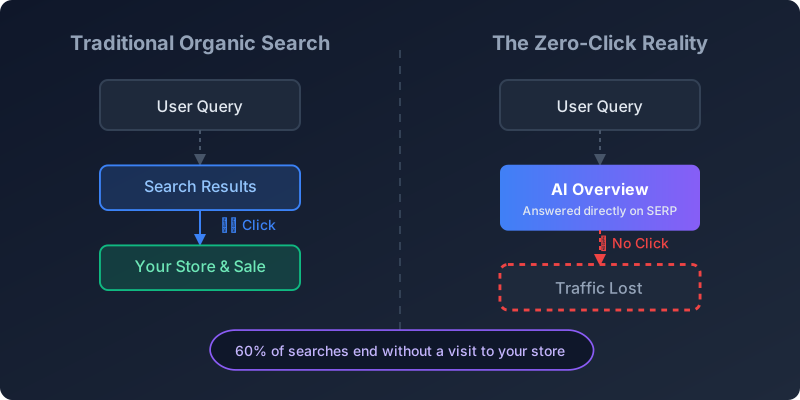
For e-commerce, this is devastating. According to a Kellogg School of Business analysis, retailers saw traffic drops of 20-40% in 2025, with most of that decline coming from lost organic search traffic. Not because their rankings fell, but because rankings stopped mattering the way they used to.
Google’s AI Overviews scrape your product content, summarize it, and present it to the searcher — without sending them to your store. You’re still “visible” in the technical sense. You’re just not getting the visit, the session, or the sale.
One merchant put it bluntly: they asked 10 SEO experts what to do, got 10 different answers, implemented them all, and have been waiting for tangible results since 2023.
What the Old Playbook Gets Wrong
If the traffic decline were a temporary algorithm fluctuation, the standard response — optimize harder, spend more on ads, diversify content — would work. But this isn’t a fluctuation. It’s a structural shift in how buyers find and purchase products.
Here’s what merchants have been trying, and why it’s not working:
Doubling down on SEO — You can’t out-optimize a system that’s designed to keep users on Google’s property. The rules of the game changed, and the new rules don’t reward the same plays.
Increasing ad spend — CPCs rise year over year while conversion rates flatline. One merchant spent $200 on Google Ads, got 900 clicks, and made zero sales. Paid acquisition without organic discovery is, as one store owner described it, “not building a brand — building a time bomb.”
Content marketing — Google’s AI Overviews summarize your content without sending traffic. You’re effectively training Google’s answer engine at your own expense.
CRO and conversion optimization — Valuable, but it optimizes a shrinking denominator. Improving conversion rate on declining traffic is arithmetic, not strategy.
Social media — Drives awareness, but average e-commerce conversion from social channels sits at 0.91%. You can’t run a business on likes.
None of these approaches are wrong. They’re just insufficient for a world where the primary discovery mechanism no longer sends people to your store.
Where Buyers Are Actually Going
While organic search traffic declines, a different channel is growing at a rate that’s hard to ignore.
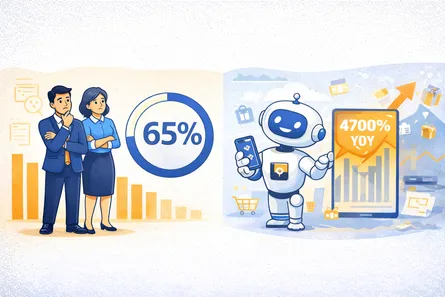
AI-driven retail traffic grew 4,700% year-over-year according to Adobe. Traffic referred by large language models converts at 4.4x the rate of traditional organic search visitors. Over 700 million people use ChatGPT every week — and as of September 2025, they can complete purchases directly inside the conversation.
Google is rolling out native shopping in AI Mode. Microsoft Copilot is integrating product recommendations. Perplexity is building commerce features. Gartner projects that by end of 2026, more than 50% of consumers will use AI shopping assistants regularly.
This isn’t speculative. It’s measurable today.
- 4,700% year-over-year growth in AI-driven retail traffic (Adobe)
- 4.4x organic conversion rate for LLM-referred visitors
- 700M+ weekly ChatGPT users who can buy in-conversation
- 50%+ of consumers using AI shopping assistants by end of 2026 (Gartner)
The critical difference: these AI agents don’t browse websites. They query structured data, evaluate product attributes, assess merchant trust signals, and make recommendations — all without visiting a traditional product page. If your store can’t respond to those queries, you don’t exist in this channel.
The Visibility Gap
Traditional e-commerce visibility works like this: you optimize your store, search engines index it, shoppers find you through queries, and they visit your site to buy.
AI agent commerce works differently: a shopper tells an AI assistant what they want, the agent searches for products that match across structured data sources, evaluates trust and fulfillment signals, and either recommends or completes the purchase — often without the shopper ever seeing your website.
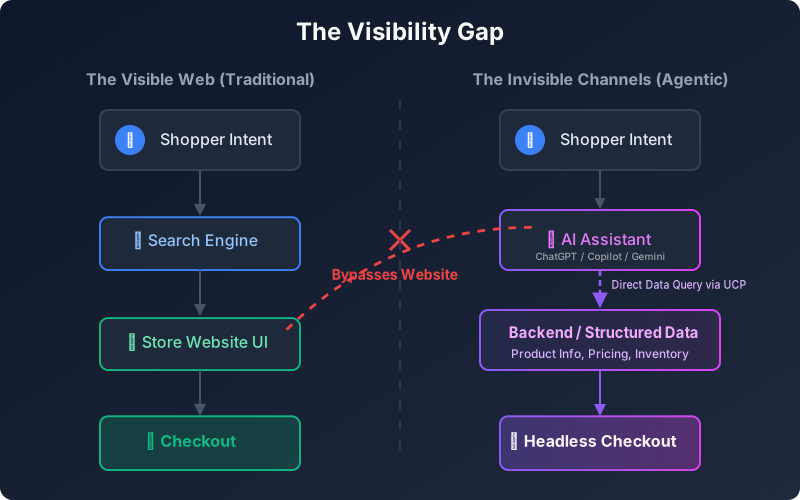
Every day your store isn’t visible to AI shopping agents, you’re losing sales to competitors who are. Not in theory. In the analytics of merchants who’ve already connected.
Why This Isn’t “The New SEO”
E-commerce operators have been promised “the new SEO” every 18 months for a decade. Voice search was supposed to change everything. Social commerce was the future. Web3 would revolutionize retail.
Agentic commerce is structurally different for one reason: it enables transactions, not just discovery.
SEO gets you found. Ads get you clicked. Social gets you followed. Agentic commerce gets you sold — inside the conversation where the buying decision happens, with checkout completed before the shopper ever opens a browser tab.
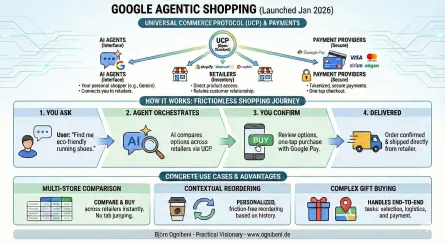
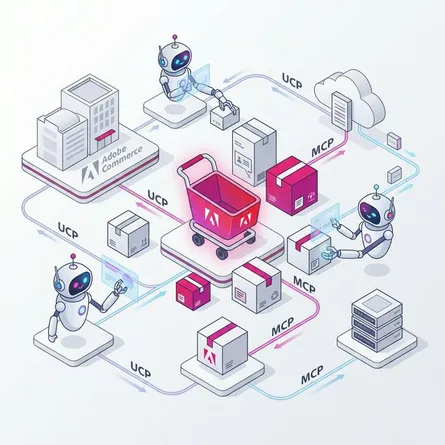
This is possible because of the Universal Commerce Protocol (UCP) — an open standard that lets AI agents discover products, check availability, and complete purchases programmatically. UCP gives agents everything they need to act on behalf of a buyer: product data, pricing, inventory, shipping options, return policies, and a secure checkout flow.
Without UCP, your store is a black box to AI agents. They can’t see your products, can’t verify your inventory, and can’t offer your checkout to shoppers.
The Platform Gap
Here’s the uncomfortable part: Shopify merchants are getting agentic storefronts natively. When Steve Madden’s VP of e-commerce says they can “automatically be wherever our customers are shopping — including inside AI conversations,” that’s not aspirational. It’s live.
If you’re on Salesforce Commerce Cloud, Adobe Commerce, WooCommerce, or a custom platform, you don’t have that. UCP is an open protocol — any platform can implement it — but your platform vendor hasn’t shipped it yet, and they haven’t committed to a timeline.
This mirrors what happened with mobile commerce. Merchants on platforms that adapted early captured the channel. Everyone else spent years catching up.
The difference this time: the adoption curve is steeper. AI agent traffic is growing exponentially, not linearly. The window between “early mover advantage” and “table stakes” is measured in months, not years.
What You Can Do Now
You don’t need to re-platform. You don’t need to understand the UCP spec, MCP, A2A, or any of the protocol alphabet soup. You need your store to be findable and transactable when AI agents look for products in your category.
1. Understand Your Exposure
Check your analytics for AI-referred traffic. Look at your Search Console for impression-to-click ratios over the past 12 months. Quantify how much of your discovery funnel depends on channels that are structurally declining.
2. Assess Your Agent Readiness
Can an AI agent today find your products, understand your pricing, verify your inventory, and complete a checkout? If the answer is no to any of those, you have a gap that’s costing you revenue in the fastest-growing commerce channel.
3. Prioritize Structured Data
Even before UCP implementation, making your product data comprehensive, consistent, and machine-readable improves your position everywhere — traditional SEO, marketplace listings, and agent discovery. This is the highest-ROI investment regardless of timeline.
4. Don’t Wait for Your Platform Vendor
Salesforce, Adobe, and BigCommerce will eventually ship native UCP support. Eventually. The merchants who are live on agentic channels when that happens will have months of transaction history, trust signals, and optimization data that latecomers won’t.
Early movers in AI commerce are building compounding advantages. Recommendation algorithms favor stores with transaction history. The longer you wait, the harder the gap is to close.
Not sure where you stand? Run the Agent Commerce Simulation to see exactly where AI agents get stuck trying to buy from your store, or talk to us about getting your catalog live on agentic channels.