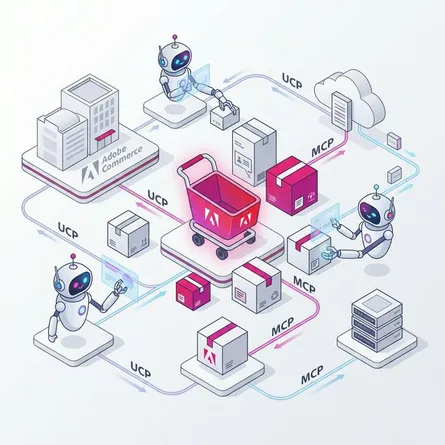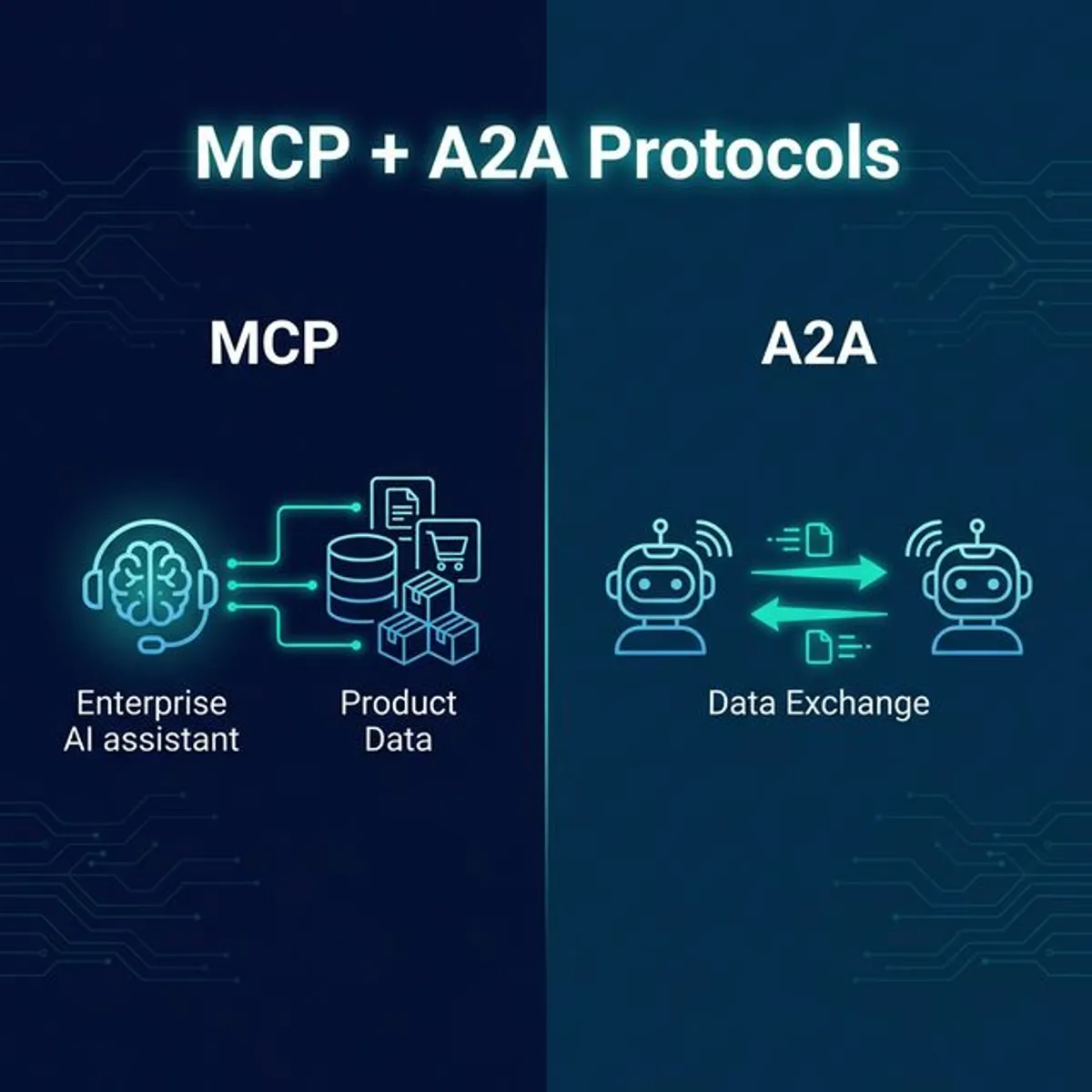

MCP (Model Context Protocol) and A2A (Agent-to-Agent) are two open protocols that operate alongside UCP in enterprise agentic commerce. MCP, developed by Anthropic, enables AI systems to query structured data sources — including product catalogs and inventory — through standardized tool definitions. A2A, developed by Google, enables AI agents to delegate tasks to other specialized agents. Together, UCP + MCP + A2A form the full protocol stack required for end-to-end agentic commerce readiness.
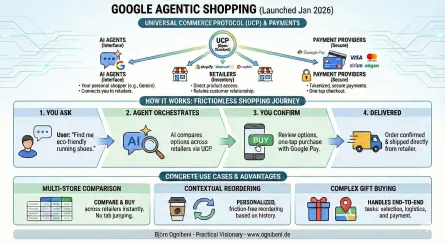
Most commerce teams have heard of UCP by now. If you haven’t — it’s the Universal Commerce Protocol, the open standard that lets AI shopping agents like Google’s find, evaluate, and purchase products on behalf of consumers.
UCP is important. But it’s only one layer of the agent economy your brand needs to be ready for.
Two other protocols — MCP (Model Context Protocol) and A2A (Agent-to-Agent) — are already powering enterprise AI workflows, B2B procurement automation, and the infrastructure behind AI shopping assistants. And most enterprise commerce teams have no plan for either.
Why Three Protocols?
The agent economy isn’t monolithic. Different AI systems have different access patterns, different trust models, and different use cases. The protocol landscape reflects that.
Think of it this way:
- UCP is for consumer-facing AI agents — the AI that helps your customer find and buy products
- MCP is for tool-using AI systems — agents that integrate with enterprise software and need structured access to your product and order data
- A2A is for agent-to-agent communication — automated workflows between AI systems, especially in B2B and supply chain contexts
A consumer shopping agent, an enterprise procurement bot, and a supply chain optimization system all need to interact with your commerce infrastructure — but they interact differently, with different security requirements and data access patterns.
flowchart LR
  C["Consumer"] --> CA["Shopping agent"]
  CA -->|"UCP"| S["Your commerce stack"]
  E["Enterprise buyer"] --> ET["AI tool"]
  ET -->|"MCP"| S
  PA["Buyer's procurement agent"] -->|"A2A"| SA["Your supplier agent"]
  SA --> S
Three protocols, three surfaces: consumer shopping agents (UCP), enterprise AI tools (MCP), and autonomous agent-to-agent workflows (A2A) all reach the same commerce stack.
MCP: The Enterprise Access Layer
Anthropic’s Model Context Protocol has been widely adopted as the standard way AI assistants integrate with enterprise software. Slack, Notion, Salesforce, GitHub — they all expose MCP servers. Enterprise AI tools like Claude for Work and Copilot agents use MCP to access data and take actions inside corporate systems.
For commerce, the MCP opportunity is this: enterprise buyers’ AI assistants are already using MCP to interact with ERP systems, procurement platforms, and CRM tools. If your commerce infrastructure exposes an MCP server, enterprise AI systems can query your catalog, check pricing, validate availability, and trigger orders — all without a human in the loop.
Who this matters for:
- B2B and wholesale sellers with enterprise buyers
- Brands with corporate gift, bulk order, or account-based programs
- Any business where enterprise procurement decisions influence revenue
The B2B procurement case is particularly compelling. Large enterprises are deploying AI procurement systems that autonomously source, evaluate, and purchase goods within pre-approved policies. If your product data and pricing API aren’t MCP-accessible, you’re invisible to those systems.
What MCP Implementation Looks Like
An MCP server for commerce exposes capabilities that AI clients can call:
- Product search and catalog access
- Pricing by account, quantity, or relationship tier
- Stock availability and lead times
- Order history and account information
- Quote generation and approval workflows
The implementation hooks into your existing commerce APIs — it doesn’t replace them. For SFCC and Adobe Commerce platforms, this means building on top of OCAPI, SCAPI, or REST/GraphQL layers with an MCP compatibility wrapper.
A2A: The Automation Protocol
Where MCP is about AI tools accessing your data, A2A is about AI agents talking to each other — autonomously, without human involvement in each transaction.
Google’s Agent-to-Agent protocol defines how AI agents across different organizations can discover each other, negotiate capabilities, and execute multi-step workflows. The canonical use case is B2B procurement: a buyer’s procurement agent autonomously queries a supplier’s commerce agent, negotiates terms, validates against purchasing policy, and places an order.
This is already happening in enterprise supply chain. The early deployments are in manufacturing, wholesale distribution, and B2B SaaS procurement.
The commerce implications:
- Repeat orders on established terms can be fully automated
- Supplier agents can proactively notify buyer agents of price changes, stock alerts, or contract renewals
- Multi-supplier comparison shopping can happen at machine speed
- Procurement approval workflows can include AI agents as participants
The A2A Security Model
A2A introduces a trust and identity layer that UCP and MCP don’t need for consumer contexts. When agents negotiate autonomously, the system needs to verify:
- Is this agent authorized to place orders?
- What spending limits and approval thresholds apply?
- How are disputes and returns handled between agents?
- What audit trail is required for compliance?
A2A defines a capability negotiation model where agents exchange what they can do, what permissions they have, and what limits apply — before any transaction begins. For enterprise commerce implementations, this means architecting your agent infrastructure with identity, authorization, and audit logging from day one.
The Multi-Protocol Reality
The brands that win in agentic commerce aren’t choosing one protocol — they’re implementing the full stack.
A typical enterprise implementation looks like:
- UCP for consumer-facing AI agent discovery and purchase
- MCP for enterprise buyer tools, B2B account access, and integration with procurement systems
- A2A for automated B2B transactions, repeat order workflows, and supply chain integration
These aren’t competing choices. They serve different surfaces and different buyer types. A manufacturing brand might drive 70% of revenue through A2A-enabled procurement automation and 30% through UCP-enabled consumer discovery — and those percentages will vary by category and business model.
What the Competitive Window Looks Like
UCP adoption is accelerating — Shopify has native support, Google AI Mode is live, and enterprise implementations are compounding. The consumer agent channel is moving fast.
MCP and A2A adoption is earlier-stage, which means the competitive window is larger. Brands that implement B2B agent infrastructure in 2026 are building the kind of early-mover advantage that compounds over years.
The analogy: brands that built EDI capability in the 1990s to serve big-box retail buyers had a structural advantage for 20 years. Brands that implemented early e-commerce APIs in 2010 captured B2B platform integrations their competitors spent years catching up to.
The protocol stack is the new EDI. And the window to build it before your competitors is open right now.
Assessing Your Protocol Readiness
Before mapping an implementation roadmap, you need to know where you actually stand. Key questions:
For MCP:
- Do you have B2B or enterprise buyer segments?
- Are your product and pricing APIs comprehensive enough to power automated queries?
- Do you have account-based pricing or tiered access that agents would need to handle?
For A2A:
- Do you have high-frequency repeat order relationships that could be automated?
- Is your order processing infrastructure capable of handling agent-initiated transactions without human review for approved buyers?
- Do you have the identity and authorization infrastructure to grant agents appropriate access levels?
For all protocols:
- Is your product data complete enough to serve agent queries without human interpretation?
- Do you have API rate limiting and authentication that can handle automated traffic?
- Is your fulfillment infrastructure capable of handling AI-initiated orders at volume?
These questions surface the gaps that determine how long an implementation actually takes — and why “turn it on” underestimates the work.
The Right Sequencing
For most enterprise brands, the right sequencing is:
- Foundation first — Get your product data and APIs to agent-ready quality
- UCP — Consumer discovery is the highest-volume opportunity in the near term
- MCP — If you have B2B buyers, this can run in parallel with UCP
- A2A — Layer on automation for qualified repeat-order relationships
Each layer builds on the one before it. The data quality work for UCP makes MCP cheaper to implement. The API infrastructure for MCP creates the foundation for A2A.
This isn’t a three-year project. Brands on modern platforms can complete the full stack in 12–18 months. The question is whether you start now or start when your competitors are already live.
Frequently Asked Questions (FAQ)
What is the difference between UCP, MCP, and A2A?
UCP (Universal Commerce Protocol) facilitates consumer-facing AI shopping agents. MCP (Model Context Protocol) is an enterprise access layer allowing AI tools to securely query backend data. A2A (Agent-to-Agent) enables autonomous multi-agent workflows, specifically for B2B procurement automation.
Why is MCP important for B2B commerce?
MCP allows enterprise buyers’ AI assistants to directly query your catalog, check account-specific pricing, and trigger orders without a human continuously driving the interface.
How does the A2A security model work?
Unlike consumer contexts, A2A requires robust identity and authorization layers. Agents must securely negotiate their capabilities, permissions, and spending limits before executing autonomous multi-step transactions.
Not sure which protocols your business actually needs? Get your readiness score across all 7 dimensions including protocol readiness, or talk to us about mapping your specific business model to the right protocol stack.