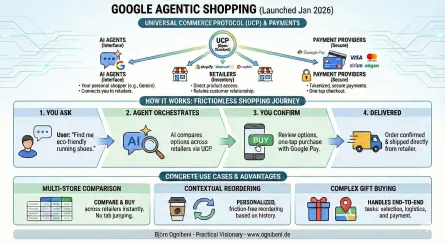
- Agentic Commerce , GEO
- 10 Feb, 2026
- · 04 Mins read
- ForkPoint Team
The Executive's Guide to GEO: Why Your SEO Budget Isn't Protecting You Anymore
SEO rankings no longer protect your brand’s AI visibility. As shoppers shift from Google Search to ChatGPT, Perplexity, and Google AI Mode, brands with excellent SEO are being omitted from AI recommendations — because AI models select products based on structured data quality, entity recognition, and content authority, not keyword rankings.
Your SEO team may be doing everything right. Rankings are up. Organic traffic is solid. And yet, when a shopper asks an AI assistant to find the product you sell, your brand doesn’t come up. This is the GEO problem — and it’s hiding in plain sight on your analytics reports.
What GEO Is (And Isn’t)
Generative Engine Optimization is the practice of making your products, brand, and content visible to AI-powered discovery systems — the language models behind Google AI Mode, ChatGPT Shopping, Perplexity, and enterprise shopping agents.
It is not a new name for SEO. The signals that determine AI recommendations are fundamentally different from the signals that determine search rankings.
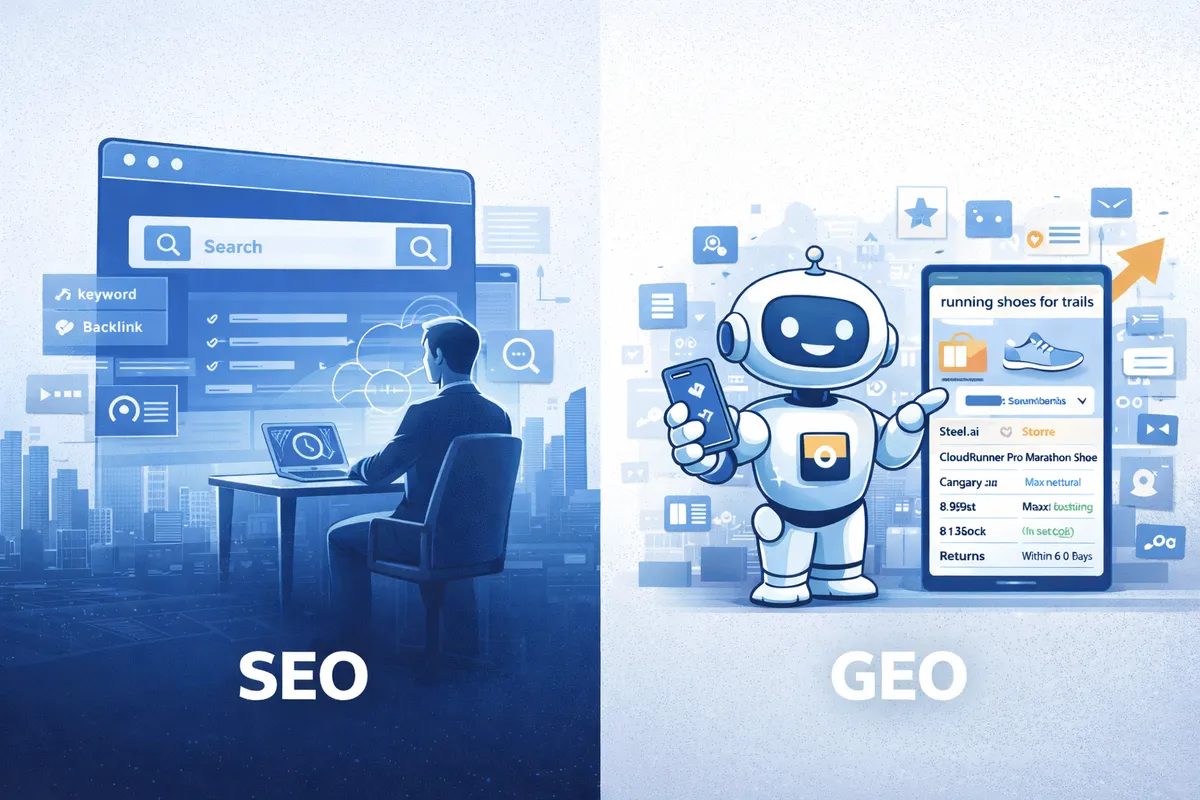
SEO is about keywords, backlinks, and crawlability. GEO is about structured data completeness, product attribute specificity, and machine-readable policy signals.
A brand can rank #1 for “running shoes” on Google while being completely invisible to an AI agent processing the same query through a language model.
The Business Case You Can Actually Take to the CFO
Here’s why this matters in revenue terms.
Adobe reported that AI-driven retail traffic grew 4,700% year-over-year. Salesforce projects that agentic commerce will influence $390 billion in global retail sales by 2028. Early data from UCP implementations shows agent-referred traffic converting at 3–5x the rate of organic search traffic — because shoppers arrive having already made the decision to buy.
The math changes fast when conversion rates triple.
The question isn’t whether to invest in GEO. It’s whether your competitors get there first and build the trust signals and recommendation history that compound over time.
Why Your Current Stack Doesn’t Solve This
The instinct is to assume that existing investments will cover it:
“Our CDN and page speed will help.” Page speed is a search ranking factor. AI agents don’t load your pages to evaluate products — they parse structured data feeds, schema markup, and API responses.
“Our product content team handles discoverability.” Marketing copy optimized for human readers is not the same as machine-readable product attributes. An agent evaluating “ergonomic office chairs for back pain” needs structured fields for lumbar support type, seat height range, and weight capacity — not a paragraph about comfort.
“Our PIM will feed this.” Product Information Management systems store your data. Whether that data is structured in ways that AI agents can parse — with complete attributes, consistent naming, and standardized schemas — is a separate problem that most PIMs don’t solve out of the box.
The Four Layers of GEO Readiness
Getting your brand in front of AI agents requires investment across four layers:
1. Product Data Quality
This is the foundation. AI agents make recommendations based on what they can read and interpret. If your product data is incomplete, inconsistently structured, or conflicting across systems, agents simply can’t make confident recommendations.
Start here:
- Every product should have complete, structured attribute data — not just name and price
- Attributes should be standardized across categories (not “size” in one place and “dimensions” in another)
- Stock levels and pricing must be accurate and real-time
- Product descriptions should be factual and specific, not just promotional
Most enterprise catalogs fail this audit on 30–50% of SKUs. Fixing it is not glamorous, but it is the highest-ROI GEO investment.
2. Schema Markup and Structured Data
Schema.org is the vocabulary that AI systems understand. If your products are marked up with comprehensive schema — including attributes, reviews, availability, shipping terms, and return policies — AI agents can read and evaluate them reliably.
Going beyond basic Product schema to include Offer, AggregateRating, ShippingDetails, and MerchantReturnPolicy adds the machine-readable context that drives recommendation probability up.
3. Discovery Infrastructure
AI agents need a way to find your product catalog systematically. This means:
- A UCP discovery manifest that exposes your catalog to agent protocols
- Comprehensive, accurate Google Merchant Center listings
- Product feeds optimized for AI consumption, not just comparison shopping engines
- Sitemap and crawlability standards for structured product data
4. Trust Signals
Agents are trained to recommend trustworthy merchants. Trust signals that matter:
- Verified reviews on major platforms
- Clear, specific return and refund policies at predictable URLs
- BBB accreditation and rating
- Accurate business information and contact details
- Secure checkout certification
These aren’t new investments — but ensuring they’re in place, current, and machine-readable is part of GEO readiness.
Where to Start: The 90-Day GEO Foundation
You don’t need to solve everything at once. Here’s a sequenced approach:
Days 1–30: Audit and Baseline
- Run a structured data audit against your top 500 SKUs
- Identify attribute gaps and inconsistencies
- Benchmark your current Schema.org coverage
- Check Google Merchant Center health and completeness
Days 31–60: Data and Schema
- Fix critical attribute gaps in high-priority categories
- Implement or upgrade Product schema to include the full attribute set
- Add ShippingDetails and MerchantReturnPolicy schema
- Submit updated feeds to Merchant Center
Days 61–90: Discovery and Measurement
- Deploy a UCP discovery manifest for your catalog
- Set up tracking for AI-referred sessions (user-agent detection)
- Establish baseline conversion rates for agent traffic
- Report to leadership on early signals
A 90-day foundation gives you measurable progress, a clear ROI story, and the infrastructure to layer protocols and optimization on top.
The Compounding Advantage
The brands that invest in GEO now are building something that compounds.
AI systems learn from performance. Merchants whose products consistently convert when recommended build recommendation history that makes future recommendations more likely. Trust signals accumulate. Attribute completeness improves. The gap between early movers and late movers widens every quarter.
This is structurally similar to what happened with SEO in 2005–2010. The brands that invested early built domain authority that took late movers years to catch up to.
Being recommended by AI agents isn’t just a traffic channel. It’s a trust asset that appreciates over time.
The Conversation to Have This Week
If you’re a VP of eCommerce or a CTO reading this, the conversation to have this week is with your head of SEO or digital marketing: “Are we measuring AI-referred traffic separately? Do we have a GEO plan?”
If the answer is no — you’re not behind yet, but the window is closing.
Want to know exactly where you stand? Run the free Agent Commerce Simulation to see how an AI agent experiences your store across all 7 dimensions, including GEO. Or talk to our team about a full GEO audit.