On May 19, 2026, Google published a post titled “Introducing the Universal Cart and more ways to help you shop.” It reads like a consumer feature announcement. It is actually one of the biggest structural changes to online retail in a decade.
If you own or run an ecommerce brand, this post is for you. No protocol diagrams you need a PhD to read, no acronym soup. Just: what Google announced, why it matters for your store, and what to do about it.
The One-Sentence Version
Google built a single shopping cart that works across every store, and an AI (Gemini) does the shopping for the customer.
That’s it. That’s the whole thing. Everything below is just unpacking what that sentence costs you — or earns you.
What’s a “Universal Cart,” in Plain English
Today, every store has its own cart. You add Nike socks to a cart on nike.com, Wayfair lamps to a cart on wayfair.com, and Target snacks to a cart on target.com. Three sites, three carts, three checkouts.
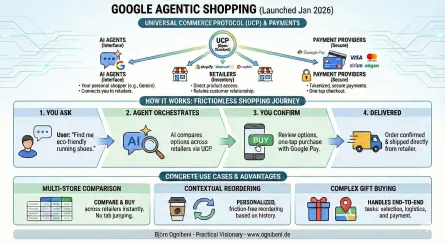
The Universal Cart collapses all of that into one basket that lives inside Google — across Search, the Gemini app, and (soon) YouTube and Gmail. The customer never visits your website to add the item. They tell Gemini what they want, Gemini fills one cart from many different stores, and they check out once with Google Pay.
 One cart, many stores. The shopper talks to Gemini; Gemini fills a single basket and checks out in one tap.
The list of launch partners is not a list of startups: Nike, Sephora, Target, Ulta Beauty, Walmart, Wayfair, Shopify, Fenty, Steve Madden, Best Buy. When those names line up behind a checkout standard, it stops being optional.
The Part That Should Get Your Attention
Here’s the quiet bombshell. The Universal Cart checks out using the Universal Commerce Protocol (UCP) — the same open standard this entire site is about.
Six months ago, “AI agents will buy things on a customer’s behalf” was a slide in a strategy deck. As of this announcement, it’s a shipping feature backed by Google and the biggest retailers on earth. The theoretical future quietly became the current quarter.
In short: the channel everyone said was “a 2027 problem” is launching this summer.
What Actually Changes for Your Brand
The mechanics matter less than the shift in where the sale is won. For twenty years, you competed on your own website: your design, your copy, your photography, your checkout. You controlled the page, so you controlled the persuasion.
In the Universal Cart world, the customer may never see your page. They ask Gemini, and Gemini compares products using your raw data — your prices, your stock levels, your attributes, your structured product feed. The AI is the new shopper, and it doesn’t care how pretty your hero banner is. It cares whether your data is complete, accurate, and machine-readable.
 The fight used to be won on your web page. Now it’s won in the data the AI reads before it ever considers your store.
Read that diagram twice. The skills that made brands win the last era — beautiful PDPs, clever banners, A/B-tested buttons — are largely invisible to an AI agent. The skills that win the next era are boring and unglamorous: clean attributes, consistent naming, real-time inventory, a proper UCP feed. The winners won’t be the prettiest stores. They’ll be the most legible ones.
How the Magic Actually Happens (The 30-Second Tech Tour)
You don’t need to implement any of this yourself to understand it. Three pieces do the work:
 Discover → Decide → Pay. UCP exposes your catalog, Gemini reasons over it, AP2 + Google Pay settle the transaction safely.
- Discover — UCP (Universal Commerce Protocol). This is how an AI reads your catalog, prices and stock in real time. No UCP, no visibility. The AI literally cannot consider products it can’t see.
- Decide — Gemini. Google’s AI compares options, spots problems (the classic example: flagging that two parts won’t work together), factors in offers and loyalty, and recommends what to buy.
- Pay — AP2 (Agent Payments Protocol) + Google Pay. A new protocol that lets an agent pay on the customer’s behalf, safely — using tamper-proof “mandates” so the AI can’t go rogue and buy a yacht. Google says AP2 rolls out to its products in the coming months, starting with Gemini Spark.
flowchart LR
  A["Shopper asks Gemini"] --> B["Gemini reads catalogs via UCP"]
  B --> C["One Universal Cart"]
  C --> D["Checkout via AP2 + Google Pay"]
  D --> E["Merchant ships, books revenue"]
The full loop: UCP for discovery, Gemini for the decision, AP2 + Google Pay for payment — and you stay the seller of record.
If you only fix one thing first, fix box one. UCP is the front door. The other two are Google’s problem; the first one is yours.
”Okay, But Is This Live Yet?”
Mostly yes, and the runway is short:
- This summer (2026): Universal Cart goes live across Google Search and the Gemini app in the U.S.
- Following that: rolls into YouTube and Gmail — meaning a YouTube product mention or a Gmail receipt can become a buy button.
- Coming months: UCP checkout expands to Canada and Australia, with the U.K. after.
So if you sell in the U.S., the answer to “when do I need to care?” is this quarter, not next year.
What a Brand Owner Should Actually Do Monday
Don’t panic-buy a six-figure platform migration. Do these, in order:
- Check your product data quality. Inconsistent attribute names, missing descriptions, stale inventory, prices that disagree between systems — every one of those is an invisible “no” to an AI agent. This is unglamorous and it is the single highest-leverage thing you can do.
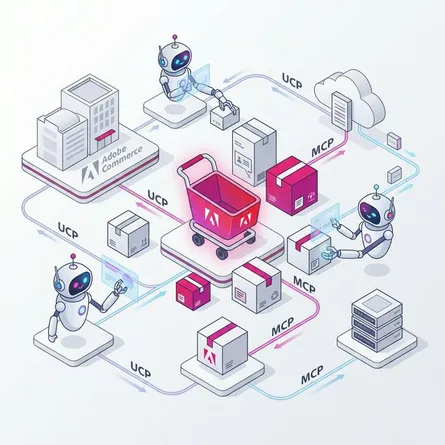
- Find out if your platform speaks UCP. Spoiler: most don’t yet, natively. Salesforce Commerce Cloud and Adobe Commerce haven’t shipped it. “Wait for the platform” is a 12–24 month bet against a channel that’s live this summer.
- Get discovery live before checkout. You can expose your catalog to agents — get seen — well before you wire up full agentic checkout. Visibility first, transactions second.
- Instrument it. How many agent sessions hit your catalog? What are they recommending? You can’t optimize a channel you aren’t measuring.
The brands that move now bank something the latecomers can’t buy later: historical data, trust signals with the agents, and brand association in the “AI recommends ___” slot. That slot has room for a few names per category. Not fifty.
The Honest Bottom Line
The Universal Cart is genuinely good for shoppers — one basket, smart deal-hunting, one-tap checkout. For brands, it’s a fork in the road. You either become the product an AI confidently recommends, or you become the option it skips because your data was a mess.
The good news: the requirement is concrete and fixable. Clean your data. Speak the protocol. Get measured. None of that requires permission from Google — it requires getting your house in order before the channel scales past you.
Want to know where an AI agent gets stuck in your store right now? Run the Agent Commerce Simulation to see exactly where an agent gives up — or book a call and we’ll walk your catalog with you.
Keep reading:
- What is Universal Commerce Protocol? A technical primer
- The 65% Problem: Why Most Retailers Aren’t Ready for Agentic Commerce
- Agentic Commerce: Visual Insights and Commentaries
Source: Google, “Introducing the Universal Cart and more ways to help you shop”, May 19, 2026.