Have you ever watched the movie Catch Me If You Can?
It’s based on the true story of Frank Abagnale Jr., one of the most notorious con men in history.
Throughout his “career,” he conned people into believing almost anything. One day he pretended to be a pilot and walked right onto commercial planes. The next, he worked as a pediatrician in a hospital. Then he went on to forge bank checks so convincing that even bank tellers couldn’t tell them apart from the real ones.
And somehow, he got away with all of it for years.
But when the FBI finally caught him, one thing still didn’t make any sense. They understood how he faked the checks and got the uniforms, but there was one stunt he pulled that seemed completely impossible.
So, they asked him directly:
“Mr. Abagnale, how did you pretend to be a university professor and teach students sociology for an entire semester… without knowing anything about sociology?”
They probably expected some elaborate scheme or genius-level explanation, but his answer was shockingly simple.
He just said: “It was actually quite easy. I just opened the textbook before each class and studied the next chapter. Then I held a presentation about it.”
That was the whole strategy. No secret formula. No hidden trick. All he needed to do was stay exactly one step ahead of his students, and they never realized what was happening.
We’re obviously not telling you to become a con artist. But there is a powerful business lesson buried in this story: You don’t need to know everything before you start taking action. You just need to be one step ahead of the curve.
And right now, that is exactly how the e-commerce AI transition works.
The AI Paralysis in E-Commerce
If you are an e-commerce director, founder, or VP of digital, you are likely feeling completely overwhelmed.
Every morning, your feed is flooded with updates about new Large Language Models (LLMs), agent frameworks, Model Context Protocol (MCP), agent-to-agent (A2A) communications, and custom API integrations. The sheer volume of technical noise makes it feel like you need a PhD in computer science just to formulate a roadmap.
As a result, many brand leaders fall into a pattern of strategic paralysis. They wait. They tell themselves they will wait until the industry “settles down,” until a clear winner emerges, or until they “have it all figured out.”
But waiting is a choice with real consequences.
The industry isn’t waiting. The consumer buying patterns are shifting underneath us, and the gap between those who take action and those who wait is widening rapidly.
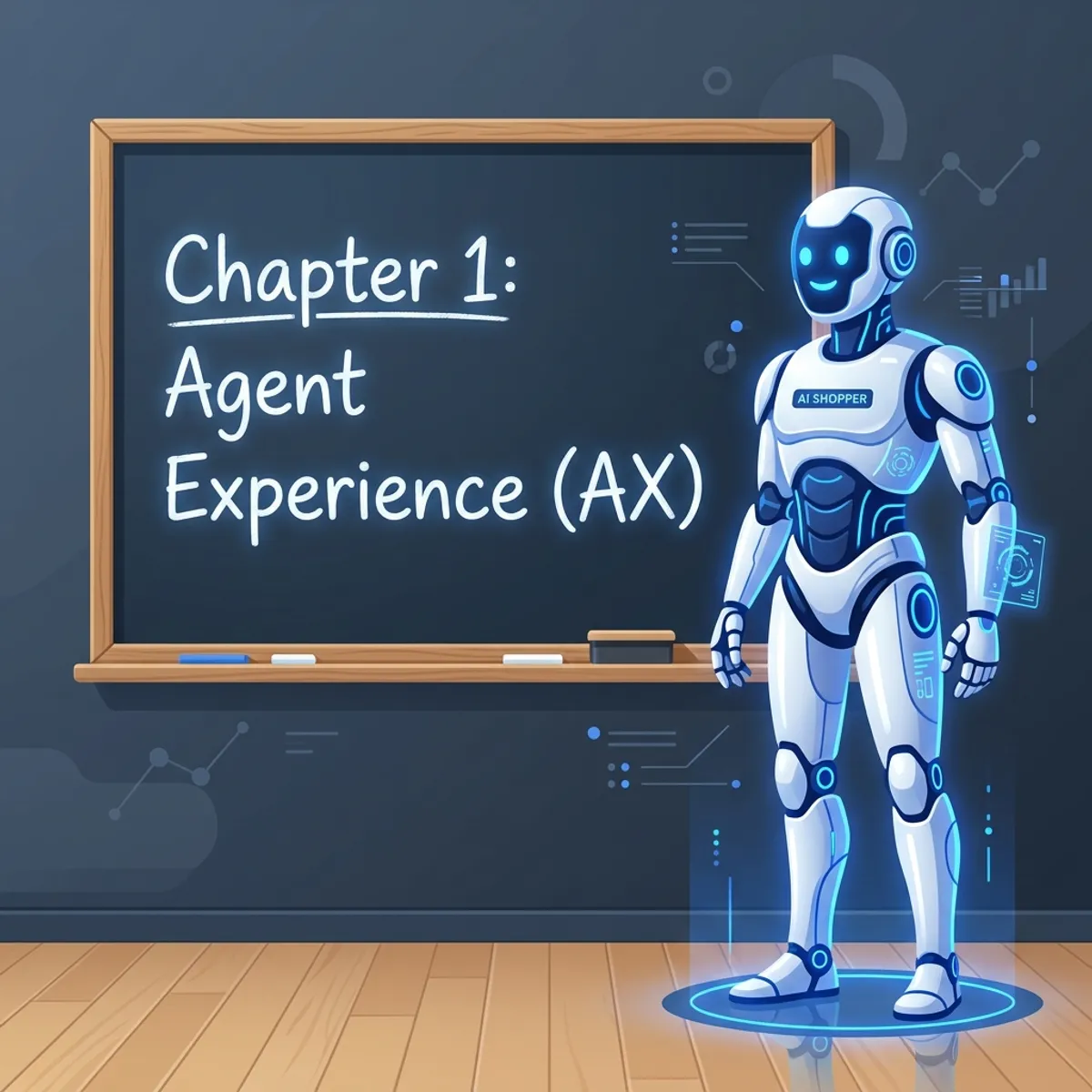
Staying One Chapter Ahead
Most business owners are not looking to build the next artificial general intelligence. Your customers aren’t looking for you to understand the inner workings of transformer models.
They just need you to help them take the next practical step so that shopping with you is seamless.
In 2026, that next step is adapting to Agentic Commerce—the transition from a world where humans browse visual storefronts to a world where AI shopping agents find, evaluate, and purchase products on their behalf.
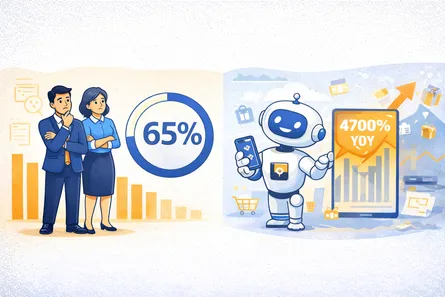
With 60–70% of organic Google searches now ending in “zero-click” results (where the user gets an AI summary and never visits your website), the old SEO playbook is broken. Consumers are beginning to delegate their purchases to AI assistants.
You don’t need to build these assistants. Google, Microsoft, Perplexity, and OpenAI are doing that for you.
Your only job—your “next chapter”—is to make sure that when those AI agents look for products in your category, they can read your store and complete a transaction.
If you can do that, you are already one step ahead of 95% of your competitors.
Universal Commerce Protocol: The Next Practical Step
Frank Abagnale didn’t write the sociology textbook. He just read it.
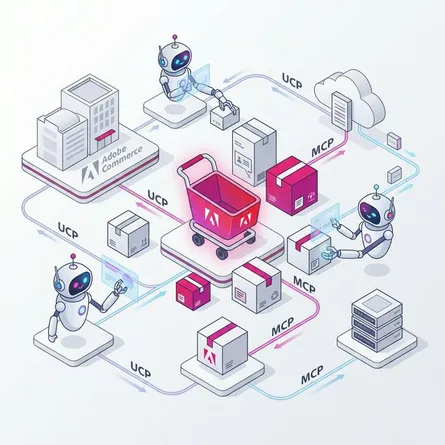
Similarly, you don’t need to design custom APIs for every AI assistant on the market. That would be an engineering nightmare. Instead, you just need to implement a single open standard: the Universal Commerce Protocol (UCP).
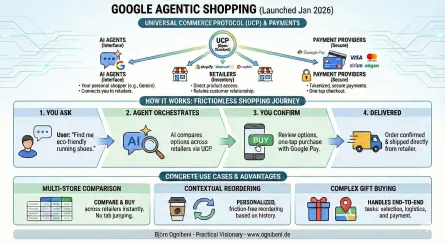
UCP is the open-source protocol that lets AI agents programmatically discover your catalog, check real-time inventory, evaluate product attributes, and complete checkouts.
flowchart LR
  A["AI agent"] --> B["Discover catalog"]
  B --> C["Check inventory"]
  C --> D["Evaluate attributes"]
  D --> E["Complete checkout"]
What UCP lets an AI shopping agent do on your storefront, end to end.
By implementing UCP on your storefront:
- You become visible to AI agents: Instead of being a visual-only website that bots struggle to scrape, your store declares its inventory in a clean, machine-readable format.
- You enable autonomous checkout: The UCP framework allows AI agents to securely pass shipping details and payment tokens, enabling end-to-end purchasing directly inside the chat interface.
- You protect your future traffic: When traditional search traffic drops, you capture the high-converting traffic driven by LLMs.
You don’t need to change your underlying platform (whether you run Salesforce Commerce Cloud, Adobe Commerce, Shopify, or a custom stack). You just need to install the UCP layer.
Stop Waiting for the Perfect Moment
The shift to agentic commerce is happening on a much faster adoption curve.
Early movers who connect their storefronts to the agentic ecosystem today are building compounding advantages:
- Transaction history: Recommendation algorithms favor stores with a proven record of successful UCP transactions.
- Trust signals: AI agents prioritize merchants with verified inventory and clear shipping APIs.
- Early data: You learn how agents search for your products and can optimize your data feeds before your competitors even get started.
You don’t need to know everything about the future of AI. You just need to be exactly one step ahead. And that step is making your store ready for the agents that are already here.
Want to know where you stand? Run the free Agent Commerce Simulation to see exactly where AI agents get stuck trying to buy from your store, or talk to our team about getting your catalog live on agentic channels.