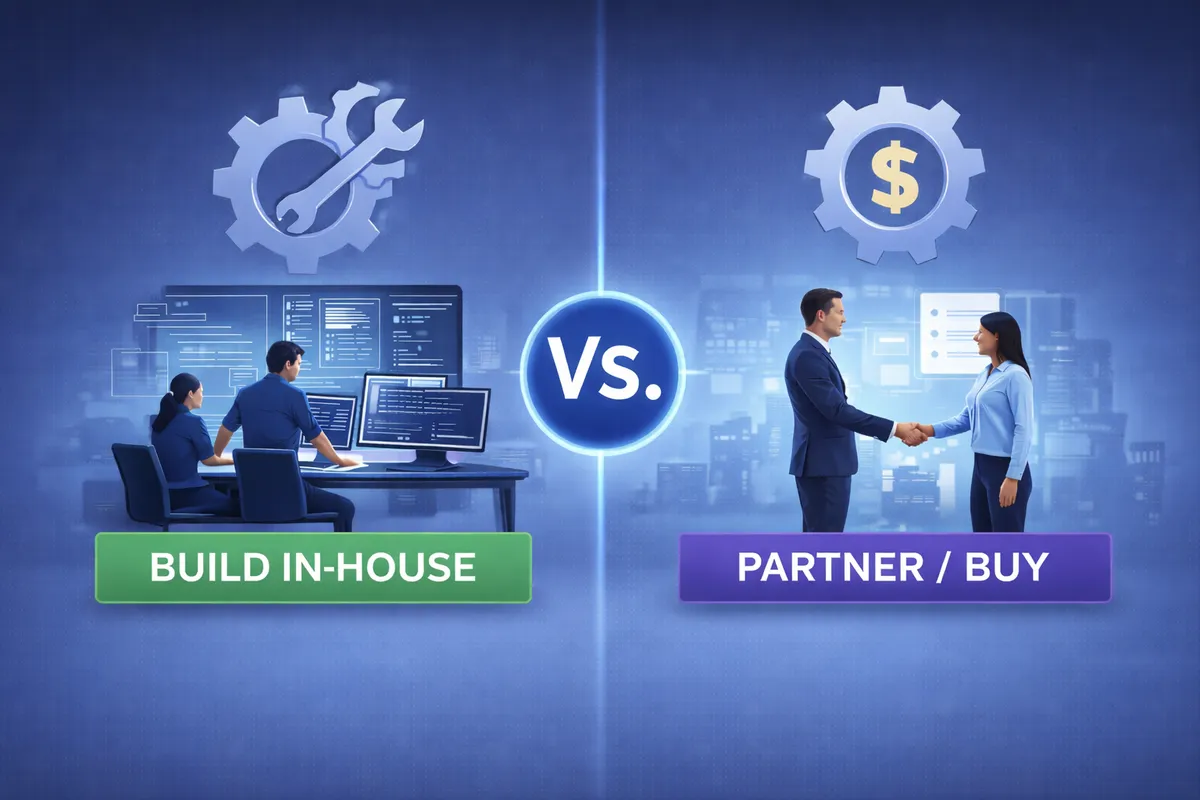

The decision to build UCP implementation in-house versus partnering with specialists comes down to three factors: your team’s existing protocol experience, your target go-live timeline, and your platform’s current state of native UCP support. For most enterprise teams on SFCC or Adobe Commerce, partnering is 3–6x faster to production; for Shopify Plus teams with strong developer capacity, in-house is often viable.
“We’ll just build it ourselves.”
It’s a reasonable instinct. Your team knows your platform. You have developers. UCP is an open protocol with public documentation. How hard can it be?
Sometimes building in-house is the right call. Sometimes it’s a costly mistake that delays your time to market by 6-12 months. This framework helps you decide.
- 3–6x faster to production when partnering, for most enterprise teams on SFCC or Adobe Commerce
- 2–3x the initial estimate — typical duration of an in-house UCP build
- 1.3–1.5x visible costs — the hidden-cost multiplier of partnering, vs 2–3x for building
The Decision Matrix
Four factors determine whether build or buy makes sense:
| Build In-House | Partner/Buy | |
|---|---|---|
| Team Expertise | Deep platform + protocol knowledge | Limited UCP experience |
| Timeline | 6+ months acceptable | Need to launch <3 months |
| Scope | Basic capabilities sufficient | Enterprise requirements |
| Strategic Priority | UCP is a side project | UCP is critical to strategy |
Let’s examine each factor.
Factor 1: Team Expertise
Build If:
Your team has:
- Architects who’ve implemented complex protocol integrations before
- Developers with 2+ years on your specific commerce platform
- Experience with similar projects (payment gateway integrations, marketplace connectors)
- Available capacity (not just “we’ll find time”)
Partner If:
- Your team hasn’t implemented a protocol-level integration before
- Platform expertise is good but not deep
- Available developers are already at capacity
- You’d need to hire to staff the project
Reality Check Questions:
- Have we built something of similar complexity in the last 2 years?
- Can the team articulate UCP’s technical requirements without referencing documentation?
- If we estimated 8 weeks, what’s our historical accuracy on similar estimates?
Most teams overestimate their ability to deliver unfamiliar work on time.
Factor 2: Timeline
Build If:
- You’re planning for 2027+ launch
- Agentic commerce is a “nice to have,” not competitive necessity
- You can afford to iterate through multiple failed attempts
- Learning is valued over speed
Partner If:
- Competitors are already agent-enabled
- You have a specific launch target (holiday 2026, board commitment, etc.)
- The market window is closing
- Executive patience is limited
Reality Check Questions:
- What happens if we’re 6 months late?
- Are competitors already live with UCP?
- How did our last “build it ourselves” project compare to estimate?
In-house builds typically take 2-3x initial estimates. A “3-month build” often becomes 9 months.
Factor 3: Scope
Build If:
- You only need basic UCP capabilities
- Single site, single region, single brand
- Standard payment methods
- No complex business rules
- Willing to skip optimization initially
Partner If:
- Multi-site or multi-brand deployment
- Complex pricing rules (B2B, customer-specific, regional)
- Custom capabilities beyond spec
- Integration with legacy systems
- Performance requirements at scale
- 24/7 support requirements
Reality Check Questions:
- Can we launch with just the basics, or do we need full capabilities from day one?
- What happens when something breaks at 2 AM on Black Friday?
- How will we handle protocol updates and new capabilities?
Factor 4: Strategic Priority
Build If:
- UCP is an experiment to evaluate
- You’re testing market demand before committing
- Failure is acceptable
- It’s not critical to 2026 strategy
Partner If:
- Board/exec has committed to agentic commerce
- UCP is part of a larger digital transformation
- You need to move fast and can’t afford mistakes
- Success matters more than learning
Reality Check Questions:
- What did we tell the board about agentic commerce?
- How does our timeline compare to stated strategy?
- Who loses their job if this fails?
When UCP is strategic, the cost of delay exceeds the cost of partnership.
The Hidden Costs of Building
When teams calculate “build” costs, they typically undercount:
1. Opportunity Cost
What else could your developers build? If they’re building UCP infrastructure, they’re not building features that differentiate your store.
2. Learning Curve
Protocol nuances, edge cases, agent behaviors—these take months to learn. Partners have already paid this tuition.
3. Maintenance Burden
UCP will evolve. Google will update the spec. Agents will change behavior. Someone has to keep up.
4. Integration Risk
Your first implementation probably won’t work perfectly with your payment provider, OMS, and other systems. Partners have solved these integrations before.
5. Performance Optimization
Making it work is easy. Making it work fast at scale requires experience you don’t have yet.
Typical hidden cost multiplier: 2-3x visible costs.
The Hidden Costs of Partnering
To be fair, partnerships have hidden costs too:
1. Knowledge Transfer
You’ll depend on the partner initially. Building internal expertise takes intentional effort.
2. Ongoing Fees
Managed services aren’t free. Budget for ongoing costs, not just implementation.
3. Vendor Lock-in Risk
If the partner disappears or raises prices, you need a transition plan.
4. Communication Overhead
Working with external teams requires coordination. Decisions take longer.
Typical hidden cost multiplier: 1.3-1.5x visible costs.
A Decision Rubric
Score yourself on each dimension:
| Factor | Build (0 pts) | Neutral (1 pt) | Partner (2 pts) |
|---|---|---|---|
| Expertise | Deep platform + protocol | Platform only | Limited |
| Timeline | 12+ months ok | 6-12 months | <6 months |
| Scope | Basic only | Standard enterprise | Complex |
| Priority | Experiment | Important | Strategic |
Scoring:
- 0-2 points: Likely build in-house
- 3-5 points: Could go either way—evaluate deeper
- 6-8 points: Strongly consider partnering
The Hybrid Option
Many teams find success with a hybrid approach:
- Phase 1: Partner-led implementation — the partner delivers production UCP while your internal team shadows, learns, and receives documentation.
- Phase 2: Internal ownership — the internal team takes over operations, with the partner available for escalations and knowledge fully transferred.
- Phase 3: Full independence — the internal team owns everything, the partner relationship becomes optional, and future builds are done in-house.
This captures partner expertise while building internal capability.
Platform-Specific Considerations
Salesforce Commerce Cloud
Build consideration: No native UCP support. Cartridge development requires SFCC expertise. SFRA conventions matter.
Our take: Unless you have senior SFCC architects with protocol experience, partner. The open-source cartridge gives you a head start, but enterprise deployment needs expertise.
Shopify Plus
Build consideration: Native UCP support exists. “Building” is really configuration and optimization.
Our take: You can enable native support yourself. Partner for optimization, GEO strategy, and custom extensions.
BigCommerce
Build consideration: No native support yet. Custom integration via REST APIs.
Our take: API expertise is more common, but timeline matters. Partner if you need to launch before native support arrives.
Headless/Custom
Build consideration: Maximum flexibility, but also maximum work.
Our take: If you built a headless stack, you probably have the skills to build UCP. Partner for acceleration, not capability.
Making the Call
After scoring the rubric and considering hidden costs:
If you decide to build:
- Allocate 2x your initial timeline estimate
- Plan for 3x budget contingency
- Assign a dedicated team (not “spare time”)
- Accept that v1 will be suboptimal
If you decide to partner:
- Evaluate partners on platform expertise, not just UCP knowledge
- Check references from similar implementations
- Negotiate knowledge transfer into the contract
- Plan for eventual internal ownership
If you’re still unsure:
- Start with a readiness assessment
- Get an external estimate for comparison
- Make the decision with data, not instinct
Frequently Asked Questions (FAQ)
What are the main factors when deciding to build or buy UCP?
The primary factors are your engineering team’s existing protocol integration expertise, your target timeline to market (less than 6 months generally favors buying), the complexity of your scope, and the strategic priority of Agentic Commerce to your board.
Is it cheaper to build UCP in-house?
Visible costs may appear lower, but hidden costs—such as opportunity cost, developer learning curves, ongoing maintenance burden, and performance optimization overhead—typically make building in-house 2-3x more expensive than initial estimates.
Can I implement a hybrid UCP strategy?
Yes. A common hybrid approach involves a specialized partner handling Phase 1 (production implementation and knowledge transfer), followed by the internal team taking over operations in Phase 2, and achieving full independence in Phase 3.
Want an objective evaluation? Our Readiness Assessment includes build vs. buy analysis tailored to your situation. Get started.