
The OpenAI Product Feed is the pipeline that gets a merchant’s catalog into ChatGPT — and as of mid-2026, it is the single artifact behind every commercial surface OpenAI operates. Organic shopping results, Instant Checkout, and the new product feed ads beta all read from the same structured file. Products in the feed can be found, compared, and bought inside the chat; products not in it effectively don’t exist there. This post breaks down how the feed actually works — field by field, flag by flag — what presence in ChatGPT is measurably worth, and the terms that come attached.
If you sell online, this is the closest thing agentic commerce has to a Google Shopping moment: a dominant AI surface formalizing exactly how it wants your product data, and rewarding the merchants who deliver it cleanly.
One Feed, Three Surfaces
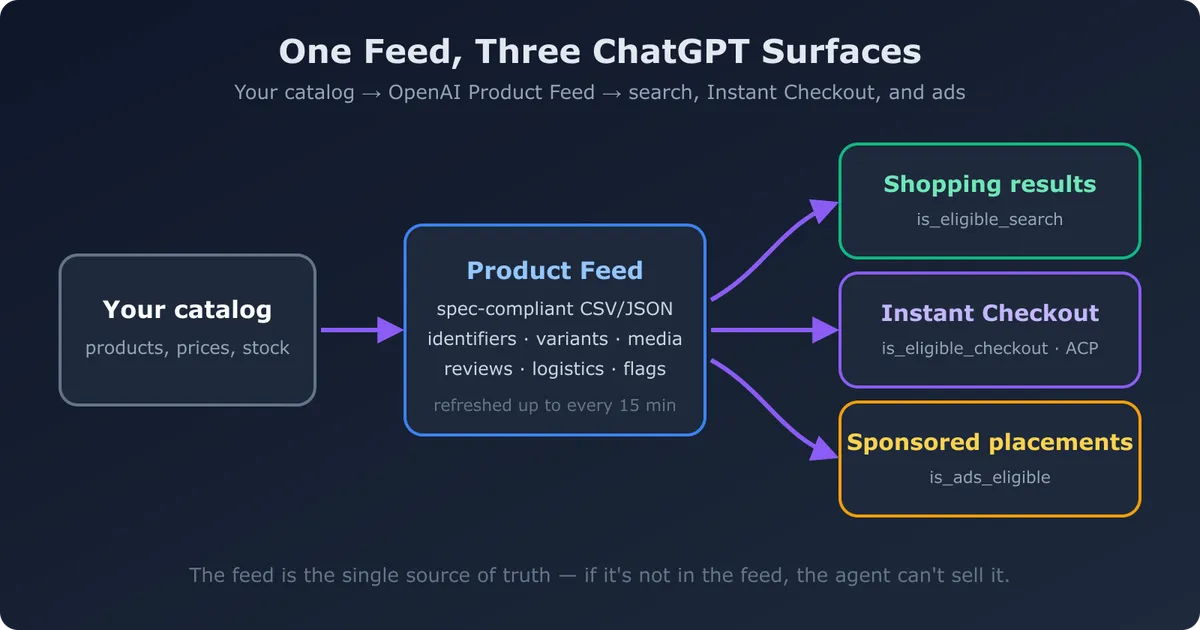
Since Instant Checkout launched in late 2025, ChatGPT hasn’t just recommended products — it sells them, with Etsy and Shopify merchants first through the door. A self-serve merchant portal followed, and in June 2026 OpenAI opened product feed ads in beta. Underneath all three experiences sits the same feed, and three boolean flags decide which surfaces each product reaches:
flowchart LR
  A["Your catalog"] --> B["Product Feed
(spec-compliant CSV/JSON)"]
  B -->|is_eligible_search| C["ChatGPT shopping results"]
  B -->|is_eligible_checkout| D["Instant Checkout
(via ACP + Stripe)"]
  B -->|is_ads_eligible| E["Sponsored placements
(ads beta)"]
One file, three doors. Search eligibility is the gateway — checkout requires it, and ads are opted into separately.
The flags compose in a strict order. is_eligible_search gets you into organic shopping results — the conversational “best waterproof hiking boots under $200” answers. is_eligible_checkout layers purchase-in-chat on top, and only works if search eligibility is on; it also triggers extra requirements (your privacy policy, terms of service, and return policy URLs). is_ads_eligible is independent: it controls whether OpenAI may process the product for sponsored placements, where ChatGPT auto-generates ad units from your feed data rather than from creative you upload.
Worth stressing: the organic side is not an auction. OpenAI surfaces products by matching structured data to conversational intent — there is no bid, no paid ranking boost, no “sponsored” tag on organic recommendations. The feed is the campaign.
What Goes in the Feed, Field by Field
The Product Feed Spec defines a flat-file schema (CSV or JSON) that OpenAI ingests and indexes. A dozen required fields keep price and availability displaying correctly; everything else is recommended — and, per OpenAI’s own docs, recommended attributes “like rich media, reviews, and performance signals improve ranking, relevance, and user trust.” The spec groups roughly into:
| Field group | Key fields | Why it matters |
|---|---|---|
| Identity | item_id (required, stable), gtin, mpn, brand | Stable IDs let the index track your product over time; GTINs let it match you against competitors |
| Content | title (150 chars), description (5,000 chars), url | This is what the model reasons over — “for whom, for what” beats keyword stuffing |
| Variants | group_id, variant_dict, color, size, size_system | Without grouping, each size/color competes against its siblings |
| Media | image_url (required), additional_image_urls, video_url, model_3d_url | Yes — 3D models. Agents render rich product cards |
| Pricing | price (required), sale_price + start/end dates, unit pricing | Sale windows are structured, not prose |
| Availability | availability (required), availability_date, expiration_date, pickup fields | in_stock, out_of_stock, pre_order, backorder — stale values kill trust |
| Logistics | shipping (country:region:service:price), is_digital, returns fields | The agent quotes delivery before the shopper ever sees your site |
| Trust | review_count, star_rating, q_and_a, reviews, store-level ratings | Feeds carry actual review content and Q&A pairs for the model to cite |
| Compliance | warning, age_restriction | Required signals for regulated or age-gated products |
| Geo | target_countries, store_country (required), geo_price, geo_availability | Region-specific price and stock in one feed |
In practice, a checkout-ready feed record looks like this:
{ "item_id": "SKU-8842-BLK", "title": "Trailhead Waterproof Hiking Boot — Black", "description": "Full-grain leather upper, Vibram sole, 200g insulation.", "brand": "Alpenrose", "gtin": "00812345678905", "group_id": "TRAILHEAD-BOOT", "variant_dict": { "color": "Black", "size": "10" }, "url": "https://alpenrose.example/products/trailhead-boot", "image_url": "https://cdn.alpenrose.example/img/trailhead-black-01.jpg", "price": "199.00 USD", "sale_price": "179.00 USD", "availability": "in_stock", "star_rating": 4.7, "review_count": 1284, "shipping": "US::standard:0.00 USD:1:3", "accepts_returns": true, "return_deadline_in_days": 30, "return_policy": "https://alpenrose.example/returns", "seller_name": "Alpenrose Outdoor", "seller_url": "https://alpenrose.example", "seller_privacy_policy": "https://alpenrose.example/privacy", "seller_tos": "https://alpenrose.example/terms", "target_countries": ["US", "CA"], "store_country": "US", "is_eligible_search": true, "is_eligible_checkout": true, "is_ads_eligible": false}Feeds can reportedly be refreshed as often as every 15 minutes, pushed over encrypted HTTPS to an OpenAI endpoint — which turns “keep price and stock current” from a weekly batch job into near-real-time plumbing. Shopify and Etsy merchants get this wired automatically through their platform integration; everyone else builds or buys the pipe.
When a shopper actually buys, the Agentic Commerce Protocol (ACP) — the open standard OpenAI built with Stripe — takes over. ChatGPT collects the buyer’s details, then creates a checkout session against your systems: you validate the order, calculate tax, take payment through your existing PSP via a shared payment token, and remain the merchant of record. OpenAI never touches the money; listing is free, and industry reporting puts the fee on completed Instant Checkout orders at around 4%.
What Feed Presence Is Actually Worth
The feed would be a curiosity if AI-referred shoppers didn’t buy. The 2026 data says they buy better than almost any channel in ecommerce.
- 13x year-over-year growth in AI-referred orders on Shopify storefronts (Q1 2026)
- 8x year-over-year growth in AI chatbot referral sessions on the same storefronts
- ~50% higher conversion rate for AI-referred visitors vs. organic search, winning in 23 of 25 merchant categories
- 14% higher average order values for AI-referred orders vs. organic search
Those four numbers come from Shopify’s Q1 2026 commerce data, and they’re corroborated elsewhere: Adobe’s Q1 2026 analysis found AI-assistant traffic converting 42% better than non-AI traffic in March 2026 — a full reversal from a year earlier, when the same channel converted 38% worse. A 12-month study of 94 seven- and eight-figure brands found ChatGPT sessions growing 1,079% across 2025 while converting 31% better than non-branded organic.
Why the quality gap? Shopify’s session data offers the mechanism: 55% of AI-referred sessions start directly on a product detail page, versus 20% for organic search. The comparison shopping — the three-to-five searches across multiple tabs — already happened inside the chat. By the time the shopper reaches you, the agent has done the funnel. You receive buyers, not browsers.
The flip side is brutal for brand visibility. Gartner projects 25% of organic search traffic shifting to AI assistants by 2026, and a conversational answer has room for a handful of products, not ten blue links and three ad slots.
In ChatGPT shopping there is no page 2 — there isn’t even a page 1. Your product is either recommended or it doesn’t exist.
For brands, that concentrates the game enormously. Winning the “AI recommends” slot in your category compounds — review signals, purchase history, and data quality feed back into ranking. Missing the feed entirely means the fastest-growing, best-converting acquisition channel in ecommerce simply routes around you, invisibly.
Ranking Is a Data-Quality Contest, Not a Copywriting One
Since organic slots can’t be bought, the levers are all in the feed. OpenAI’s own framing is explicit: required fields make you displayable, recommended attributes make you rankable. In practice that means:
- Specific, honest titles and descriptions. The model matches conversational intent (“gift for a trail runner who overpronates”) against your text. Attribute-rich descriptions outperform slogan copy.
- Complete variant structure. Ungrouped variants fragment your review counts and confuse comparisons;
group_id+variant_dictconsolidate them. - Real trust signals. The feed carries actual review content, Q&A pairs, and store-level ratings — material the agent can quote when it justifies a recommendation to the shopper.
- Live price and stock. An agent that gets burned recommending an out-of-stock product learns;
availabilityaccuracy is a ranking input, not just a courtesy. - Rich media. Multiple images, video, even GLB 3D models — the product card is the new PDP.
If this list sounds familiar, it should: it’s the same discipline that every AI shopping surface rewards. The era where a beautiful product page compensated for messy data is over; the agent never sees the page.
The Terms Attached — 60 Seconds of Fine Print
The feed program got its legal foundation on June 15, 2026, when OpenAI published the Merchant Feed Terms of Service. Read them before onboarding; the exchange, at a glance:
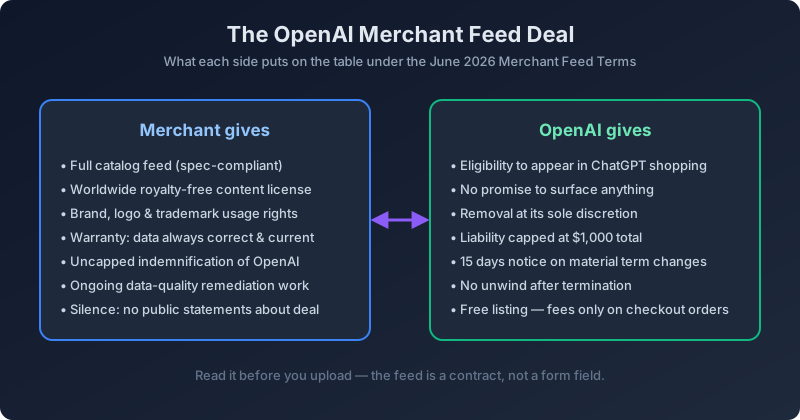 The feed is a contract, not a form field — merchants trade a broad license and hard warranties for eligibility, not guarantees.
The short version:
- You grant a broad license. Worldwide, royalty-free rights to reproduce, modify, and display your content — plus use of it for “a search index and improving the OpenAI Services,” and use of your brand and logos. Feed content is explicitly not confidential.
- Accuracy is a contractual warranty. You promise your data — pricing included — “is and will remain complete, correct and current,” and you’re obliged to fix discrepancies OpenAI flags. Your feed pipeline is now a compliance surface.
- OpenAI promises nothing back. No obligation to surface any product, removal at sole discretion, liability capped at $1,000, 30-day termination, and material term changes on 15 days’ notice.
- Category limits are real. The companion Commerce Policies (updated June 24, 2026) ban entire mainstream segments — all ingestible supplements, alcohol, nicotine, crypto/NFTs, self-defense gear, in-game currency. Filter restricted SKUs at feed level rather than risk seller-wide enforcement.
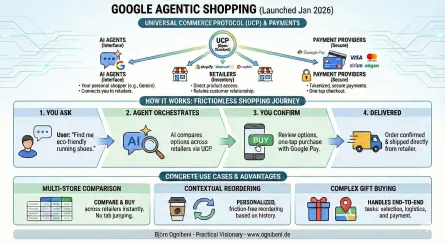
None of this is a reason not to participate — it’s the standard walled-garden bargain, priced at data instead of dollars. It is a reason not to make OpenAI’s feed your only agentic channel. The Universal Commerce Protocol approach — an open catalog surface any compliant agent can read, which Google’s Universal Cart now transacts against — is the counterweight: same data discipline, terms you control. Brands of scale will speak both.
What to Do With This on Monday
- Get the feed live. Shopify/Etsy merchants: flip the integration on. Everyone else: apply at the merchant portal and stand up the spec-compliant export.
- Fill the recommended fields, not just the required ones. Reviews, Q&A, variant groups, media, shipping — that’s the ranking surface. A minimum-viable feed is a minimum-visibility feed.
- Wire it to live data. 15-minute refresh capability is pointless against a nightly batch export — and you’ve warranted “current” anyway.
- Instrument the channel. Track AI-referred sessions, orders, and AOV separately. The Shopify numbers above are averages; you need yours.
- Build the open-rail counterpart. A UCP-native catalog gives every other agent the same clean data, on your terms.
Frequently Asked Questions
What is the OpenAI Product Feed?
A structured file (CSV or JSON, per OpenAI’s Product Feed Spec) containing a merchant’s full catalog — identifiers, pricing, availability, variants, media, reviews, and logistics. It is the single data source behind ChatGPT’s shopping results, Instant Checkout, and product feed ads.
How do products get into ChatGPT shopping results?
Submit a spec-compliant feed with is_eligible_search: true, via a platform integration (Shopify, Etsy) or directly through OpenAI’s merchant portal. Organic surfacing is based on matching structured data to the shopper’s conversational intent — there is no bidding for organic placement.
What does it cost to be in the feed?
Listing and organic discovery are free. Industry reporting puts OpenAI’s fee at around 4% on completed Instant Checkout orders only — pay-per-sale, no pay-per-click. The merchant remains the merchant of record and processes payment through its own provider.
How often can the feed be updated?
Reportedly as often as every 15 minutes, pushed over encrypted HTTPS. That cadence exists because availability and pricing accuracy directly affect both ranking and the merchant’s contractual warranty that feed data stays correct and current.
Is the product feed the same thing as the Agentic Commerce Protocol?
No. The feed handles discovery — getting products indexed and ranked. ACP is the open checkout standard (built by OpenAI and Stripe) that handles the transaction once a shopper buys in-chat: ChatGPT creates a checkout session against the merchant’s systems, and the merchant validates, charges, and fulfills.
Want your catalog ready for every agent, not just ChatGPT? Run the Agent Commerce Simulation to see exactly what agents read from your store, or book a call and we’ll walk your feed, your data quality, and your protocol options with you.
Keep reading:
- Google’s Universal Cart, Explained for Brand Owners
- What is Universal Commerce Protocol? A technical primer
- Your Store Is Invisible to AI Shopping Agents
Sources: OpenAI, Product Feed Spec and key concepts guide; OpenAI, “Buy it in ChatGPT”; OpenAI, Merchant Feed Terms of Service (June 15, 2026) and Commerce Policies (June 24, 2026); Shopify, Q1 2026 AI search insights; Adobe Digital Insights Q1 2026 via Digital Applied; Visibility Labs 2025 study via ALM Corp; Lengow, ChatGPT Product Feed.