- Agentic Commerce
- 08 Jan, 2026
- · 04 Mins read
- ForkPoint Team
GEO vs. SEO: Optimizing for AI Agent Discovery
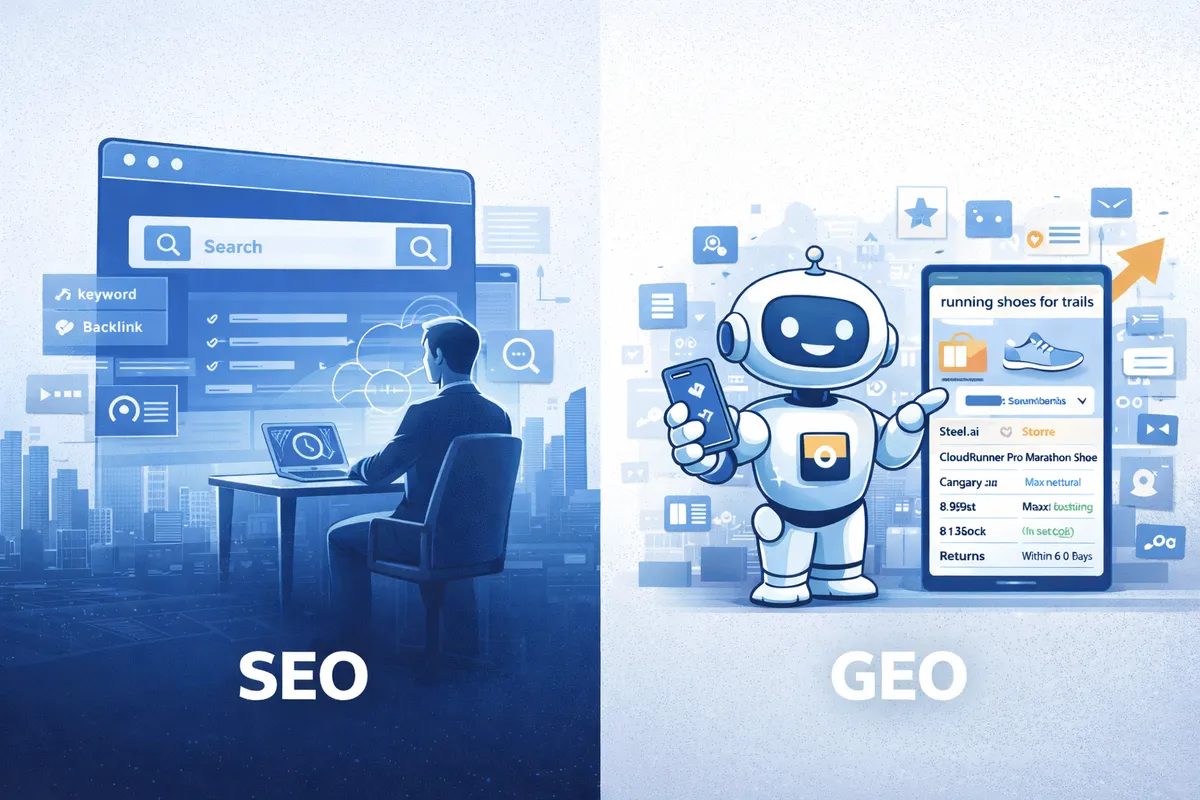
Generative Engine Optimization (GEO) is the practice of making your brand and products discoverable to AI systems like ChatGPT, Google AI Mode, and Perplexity — which surface recommendations through language models rather than keyword rankings. Where SEO targets search engine algorithms, GEO targets the structured data, content clarity, and authority signals that AI models use to decide what to recommend.
For 25 years, SEO has been the discipline of getting found in search. Keywords, backlinks, page speed, mobile optimization—a mature playbook that every e-commerce team knows. But AI agents don’t use Google Search. They use language models that process information differently, prioritize different signals, and surface results through entirely different mechanisms.
How AI Agents “Search”
When a traditional search engine ranks results, it’s evaluating:
- Keyword relevance
- Domain authority
- Backlink profile
- Page speed and Core Web Vitals
- User engagement signals
When an AI agent selects products to recommend, it’s evaluating:
- Structured data completeness
- Product attribute specificity
- Price competitiveness
- Availability confidence
- Policy clarity (returns, shipping)
- Trust signals from merchant reputation
The overlap is smaller than you’d think.
Key Differences
1. Keywords vs. Attributes
SEO mindset: “What keywords should we target on our product pages?”
GEO mindset: “Do our product attributes answer every question an agent might have?”
AI agents don’t match keywords—they understand intent. A shopper asking for “comfortable running shoes for marathon training” triggers the agent to look for:
- Product category (running shoes)
- Comfort indicators (cushioning type, weight)
- Use case suitability (long-distance, training)
If your product data says “Running Shoe - Black - Size 10” and nothing else, the agent has no signal to work with. You’re invisible.
2. Page Content vs. Structured Data
SEO mindset: “We need 1,500 words of optimized content on each product page.”
GEO mindset: “We need comprehensive, machine-readable product data in standardized schemas.”
Agents don’t read your marketing copy. They parse structured data. Schema.org markup, UCP manifests, product feeds—that’s the content that matters.
// What agents want to see
{
  "@type": "Product",
  "name": "CloudRunner Pro Marathon Shoe",
  "category": "Running Shoes > Marathon",
  "attributes": {
    "cushioning": "maximum",
    "weight": "8.5oz",
    "drop": "10mm",
    "support": "neutral",
    "surface": ["road", "track"],
    "distance": ["marathon", "ultra"]
  },
  "price": 179.99,
  "availability": "in_stock",
  "shipping": {
    "free_threshold": 50,
    "estimated_days": "2-4"
  },
  "returns": {
    "window_days": 60,
    "free_returns": true
  }
}
3. Traffic Volume vs. Conversion Quality
SEO mindset: “We need more traffic to our site.”
GEO mindset: “We need agents to recommend us to the right shoppers.”
Agent-driven traffic is fundamentally different:
- Shoppers arrive with high purchase intent
- Product already pre-selected by agent
- Comparison shopping already complete
- Price expectations already set
Conversion rates for agent-referred traffic can be 3-5x higher than organic search. But you can’t measure success in pageviews—you measure it in recommendation rate and checkout completion.
4. Backlinks vs. Trust Signals
SEO mindset: “We need more high-authority backlinks.”
GEO mindset: “We need trust signals that agents can verify.”
Agents are trained to recommend trustworthy merchants. Trust signals include:
- BBB accreditation and rating
- Verified reviews from trusted platforms
- Clear return and refund policies
- Secure payment options
- Physical business address
- Customer service availability
These aren’t new—but the importance weighting is different than traditional SEO.
5. SERP Position vs. Recommendation Probability
SEO mindset: “We need to rank #1 for ‘running shoes’”
GEO mindset: “We need to maximize probability of recommendation for relevant queries”
There’s no “page 1” in agentic commerce. There’s only: recommended or not recommended.
And the recommendation algorithm isn’t a single ranking—it’s a complex model that considers:
- Query match (does this product fit what the shopper asked for?)
- Competitive positioning (is this the best option available?)
- Merchant trust (can we confidently send a shopper here?)
- Historical performance (have previous recommendations converted well?)
You can’t reverse-engineer it like a search algorithm. You can only optimize for fundamentals.
The GEO Playbook
1. Audit Your Product Data
Start with these questions:
- Do all products have complete attributes (not just required fields)?
- Are attributes standardized across categories?
- Is pricing consistent between systems?
- Is inventory data real-time?
- Are product descriptions factual, not just promotional?
Most catalogs fail this audit. Fixing data quality is the highest-ROI GEO investment.
2. Implement Comprehensive Schema
Go beyond basic Schema.org Product markup:
- Add detailed specifications
- Include shipping and returns information
- Mark up reviews and ratings
- Specify availability by region
- Include price drop history (agents may prioritize deals)
3. Make Policies Machine-Readable
Agents need to answer: “Can I confidently recommend this merchant?”
That means your policies need to be:
- Clear and specific (not vague legalese)
- Accessible at predictable URLs
- Structured in a parseable format
- Consistent with actual practice
A 14-day return policy clearly stated beats a “generous return policy” vaguely implied.
4. Build Trust Infrastructure
- Claim and optimize your Google Merchant Center listing
- Gather verified reviews on major platforms
- Ensure contact information is accurate and accessible
- Display security badges and certifications
- Maintain BBB accreditation
5. Instrument and Iterate
GEO is nascent. The playbook will evolve as we learn more about how agents rank recommendations.
Set up tracking for:
- Agent-initiated sessions (user agent detection)
- Product recommendation rates (if measurable)
- Agent-referred conversion rates
- Post-purchase satisfaction for agent traffic
The teams that build measurement frameworks now will have the data to optimize later.
SEO Isn’t Dead
To be clear: traditional SEO still matters. Organic search isn’t going away. The majority of commerce traffic still comes through traditional channels.
But the mix is shifting. Agent-driven traffic is growing exponentially while search traffic grows linearly. The teams that master both disciplines will win.
GEO isn’t replacing SEO. It’s joining it.
Ready to optimize for agents? Learn about our agentic commerce strategy services or get your readiness score.