
Salesforce has gone all-in on “Agentforce,” positioning Einstein Service Agent as the future of customer interaction. It’s a powerful, conversational AI designed to handle support tickets, answer product questions, and guide users through a site.
But is a smarter chatbot the same as an Agentic Storefront?
Not quite. While Salesforce focuses on the conversation, the Agentic Storefront narrative (powered by UCP) focuses on the transaction. Here is the breakdown of how they differ and which one your business actually needs.
Salesforce Einstein: The Conversational Layer
Einstein is a “Copilot.” It lives on your website and waits for a human to show up and ask a question. It’s designed to improve the User Experience (UX).
- Strength: Excellent for high-touch customer service and guiding a human shopper who is already on your site.
- Weakness: It doesn’t solve the “Zero-Click” problem. If the user is on ChatGPT or Gemini and never visits your site, Einstein never gets the chance to speak to them.
Agentic Storefront: The Transaction Layer
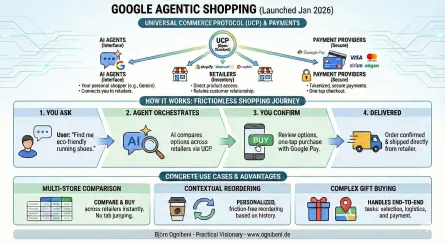
An Agentic Storefront is designed for Agent Experience (AX). It doesn’t wait for a human to visit your site. It exposes your store to the AI agents that humans use off-site.
- Strength: It enables autonomous agents (external to your site) to discover your inventory and complete a purchase without human intervention.
- Weakness: It is a protocol, not a personality. It doesn’t “chat”; it transacts.
The Core Difference: Bot vs. Agent
The industry often confuses “Bots” with “Agents.”
- A Bot (Einstein) helps a human do a task on a website.
- An Agent (Agentic Storefront/UCP) does the task for the human, wherever that human happens to be.
Can they work together?
Absolutely. In fact, for a Salesforce Commerce Cloud merchant, the ideal stack looks like this:
- Einstein handles the onsite human shoppers (UX).
- UCP Cartridge handles the off-site AI shopping agents (AX).
flowchart LR
  H["Human shopper"] --> SF["SFCC storefront"]
  SF --> E["Einstein copilot (UX)"]
  AG["Off-site AI agent"] --> UC["UCP Cartridge (AX)"]
  UC --> BE["SFCC backend"]
  SF --> BE
The ideal SFCC stack: Einstein serves onsite humans while the UCP Cartridge serves off-site agents against the same backend.
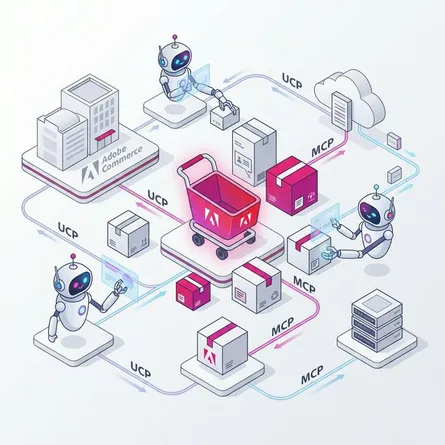
The UCP Cartridge acts as the “translator” that lets external AI agents speak the same commerce language as your Salesforce backend, effectively turning your SFCC instance into a true Agentic Storefront.
Verdict
If you want to reduce support tickets and help people find products on your site, use Einstein.
If you want to capture the 60% of searchers who aren’t clicking through to your site anymore and want to delegate their shopping to AI, you need an Agentic Storefront.