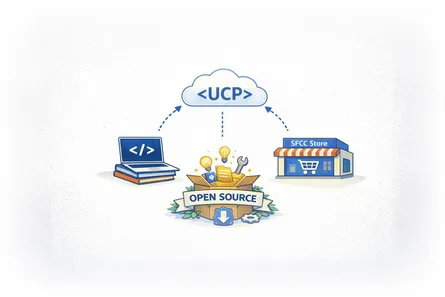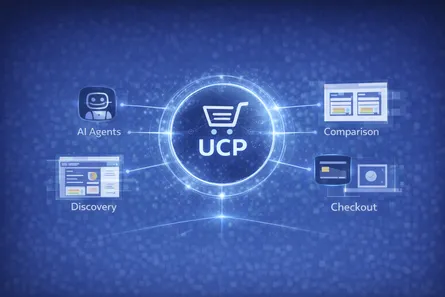

The ucp-sfcc cartridge is the first open-source, MIT-licensed implementation of Universal Commerce Protocol (UCP) for Salesforce Commerce Cloud. It enables SFCC merchants to expose a UCP discovery manifest, accept agent-initiated checkout sessions, and process payments through the standard UCP payment handler — without waiting for native Salesforce support.
Today, we’re excited to announce the release of ucp-sfcc—the first open-source Universal Commerce Protocol cartridge for Salesforce Commerce Cloud. It’s free, MIT-licensed, and ready for production use.
Why This Matters
Google’s AI Mode is live. Shoppers are already using Gemini to find, compare, and purchase products without ever visiting a traditional storefront. Universal Commerce Protocol (UCP) is the open standard that makes this possible—enabling AI agents to discover products, manage carts, and complete checkouts on behalf of shoppers.
flowchart LR
  S["Shopper"] --> G["Gemini / AI Mode"]
  G -->|"UCP"| D["Discover products"]
  D --> C["Manage cart"]
  C --> K["Complete checkout"]
UCP takes a shopper from discovery to a completed checkout without a traditional storefront visit.
We built the solution.
What’s in the Cartridge
The ucp-sfcc cartridge provides core UCP capabilities for any SFCC storefront:
- Discovery Manifest (
/.well-known/ucp) — Makes your products visible to AI agents across Google’s ecosystem - Checkout Sessions — Full cart management, pricing, tax, and shipping calculations
- Payment Handler Integration — Secure payment processing via your existing PSP
- Order Management — Real-time order status and tracking
- SFRA 6.x+ Compatible — Drop-in architecture that follows SFRA conventions
// Example: Discovery Manifest{ "name": "Your Store", "description": "Your store description", "logo": "https://yourstore.com/logo.png", "capabilities": { "product_discovery": true, "checkout": true, "payment": true, "order_tracking": true }}Why Open Source?
We believe UCP adoption benefits the entire commerce ecosystem. By open sourcing our SFCC cartridge, we:
- Lower the barrier to entry for agentic commerce
- Build trust through transparent, reviewable code
- Enable the community to contribute improvements
- Establish a standard before fragmentation occurs
The cartridge is free. Our expertise is the product.
Getting Started
Clone the repository and follow the installation guide:
git clone https://github.com/ForkPoint/ucp-sfcc.gitThe documentation covers everything from initial setup to production deployment. For enterprise deployments requiring customization, performance tuning, or integration with existing systems, contact our team.
What’s Next
This is just the beginning. We’re actively developing:
- Multi-site and multi-brand configuration support
- Advanced capability extensions
- Performance optimization tools
- Integration accelerators for common PSPs
Star the repo, submit issues, contribute PRs. Let’s build the future of commerce together.
Ready to implement UCP? Get your readiness score or view the cartridge on GitHub.